


Amid growing concerns about environmental and water resource safety, the microbiological safety of drinking water remains a critical public health issue. With the increasing complexity of water source contamination and the continuous emergence of new pathogens, traditional chemical disinfection methods (such as chlorination) are facing unprecedented challenges. Ultraviolet (UV) water purification technology, as a science-based physical disinfection method, has gradually become an essential component in both residential and industrial water treatment systems due to its broad-spectrum sterilization, lack of harmful disinfection by-products (DBPs), and high efficiency in inactivating chlorine-resistant protozoa. This article systematically outlines the key issues to understand when considering the installation of a UV water disinfection system, provides essential knowledge, and offers scientific support for your installation decision.
(*The WHO explicitly recognizes UV as an effective drinking water disinfection technology in the "Guidelines for Drinking-water Quality.")
1. Understanding the Principles of UV Water Disinfection
The core of UV disinfection lies in using electromagnetic radiation of specific wavelengths to inflict irreversible damage on the genetic material of microorganisms. Understanding this physical process is fundamental for evaluating whether this technology is suitable for a particular application.
1.1 Germicidal Mechanism of the UV-C Band
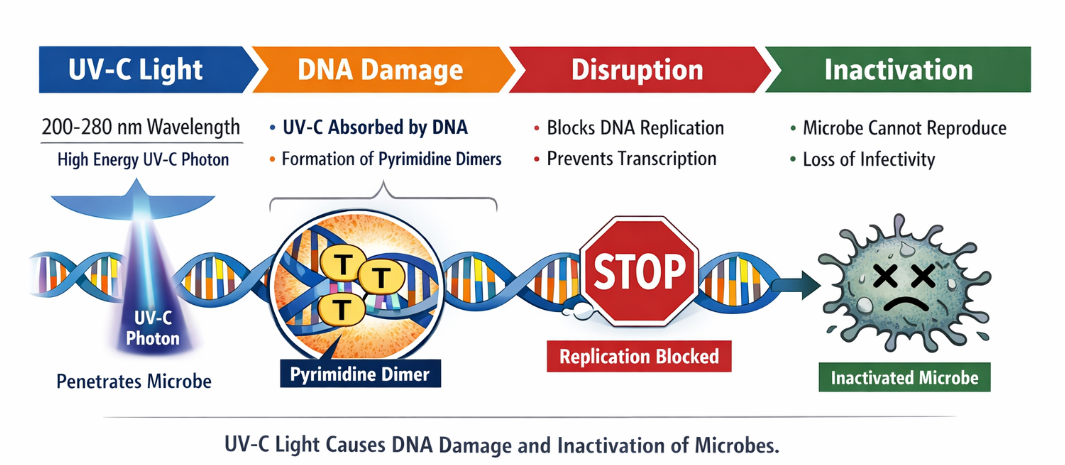
Ultraviolet light is generally divided into UV-A, UV-B, and UV-C based on wavelength, with the 200–280 nm UV-C range exhibiting the strongest germicidal capability, hence known as "germicidal UV." When microorganisms in water (such as bacteria, viruses, or protozoa) are exposed to UV-C irradiation, high-energy photons penetrate their cells and are strongly absorbed by DNA or RNA, causing adjacent bases to form "pyrimidine dimers." This is equivalent to inserting "errors" into the genetic code. These changes hinder DNA replication and transcription, preventing the microorganisms from reproducing and thereby eliminating their infectivity and pathogenicity. This process of inactivating microorganisms by damaging their genetic material is referred to as "inactivation" in the water treatment field.
Source: Journal of Hazardous Materials
1.2 UV Dose (Fluence) and Inactivation Efficiency
The effectiveness of UV disinfection is determined by the UV dose, which is calculated as:
Dose=I×t
where III represents the UV intensity (in μ W/cm² or m W/cm²), and ttt is the exposure time (in seconds). The resulting dose is typically expressed in millijoules per square centimeter (m J/cm²).
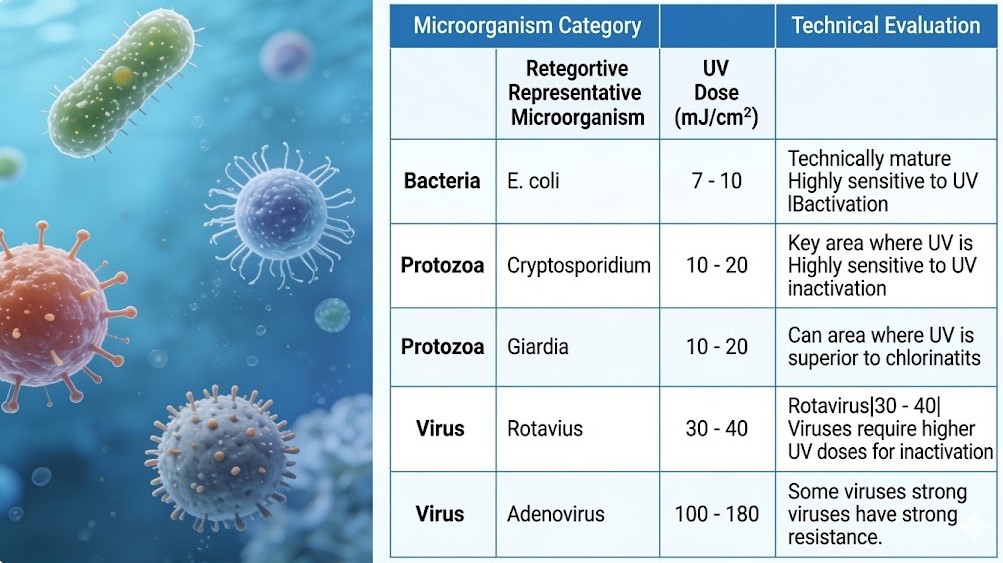
Different pathogens exhibit significant variability in their sensitivity to UV. Studies have shown that most pathogenic bacteria can be inactivated at relatively low doses.
2. Guidelines for Microbial Risk Classification of Different Water Sources
The first step in determining whether to install a UV system is to conduct a comprehensive review of the water source origin and its potential contamination pathways.
Medium-Risk Water Sources
- Typical Examples: Municipal tap water, deep well water
- Risk Characteristics: Microbial presence may include chlorine-resistant bacteria, which is a common water safety issue.
- Recommendation: Use UV disinfection as a safeguard for the water system.
High-Risk Water Sources
- Typical Examples: Shallow groundwater, private wells, certain rainwater harvesting systems
- Risk Characteristics: Microbial content can vary seasonally or after rainfall, potentially including E. coli or enterococci.
- Recommendation: Strongly recommend installing a UV disinfection system, especially during the rainy season or after flooding.
Very High-Risk Water Sources
- Typical Examples: Surface water, circulating cooling water, water towers or storage tanks with long retention times, reclaimed water systems
- Risk Characteristics: Prone to biofilm formation, supporting prolific growth of Legionella, Pseudomonas, and other pathogenic microorganisms.
- Recommendation: UV disinfection or other multi-barrier disinfection measures must be installed to ensure microbial control within safe limits.
2. Guidelines for Microbial Risk Classification of Different Water Sources
The first step in determining whether to install a UV system is to conduct a comprehensive review of the water source origin and its potential contamination pathways.
Medium-Risk Water Sources
- Typical Examples: Municipal tap water, deep well water
- Risk Characteristics: Microbial presence may include chlorine-resistant bacteria, which is a common water safety issue.
- Recommendation: Use UV disinfection as a safeguard for the water system.
High-Risk Water Sources
- Typical Examples: Shallow groundwater, private wells, certain rainwater harvesting systems
- Risk Characteristics: Microbial content can vary seasonally or after rainfall, potentially including E. coli or enterococci.
- Recommendation: Strongly recommend installing a UV disinfection system, especially during the rainy season or after flooding.
Very High-Risk Water Sources
- Typical Examples: Surface water, circulating cooling water, water towers or storage tanks with long retention times, reclaimed water systems
- Risk Characteristics: Prone to biofilm formation, supporting prolific growth of Legionella, Pseudomonas, and other pathogenic microorganisms.
- Recommendation: UV disinfection or other multi-barrier disinfection measures must be installed to ensure microbial control within safe limits.
3. Microbial Testing as a Basis for Decision Making
Water color or odor alone cannot reliably indicate microbial contamination. Laboratory water quality testing provides the scientific basis for determining the need for a UV system.
3.1 Key Bacterial Indicators
- Total Coliforms: A result of >0 CFU/100 mL indicates potential external contamination of the water source.
Source: U.S. Environmental Protection Agency
- Escherichia coli (E. coli): A positive result indicates fecal contamination; the water is unsafe for direct consumption and requires disinfection such as UV treatment.
Source: WHO – Guidelines for Drinking-water Quality
3.2 Presence of Chlorine-Resistant Pathogens in Water
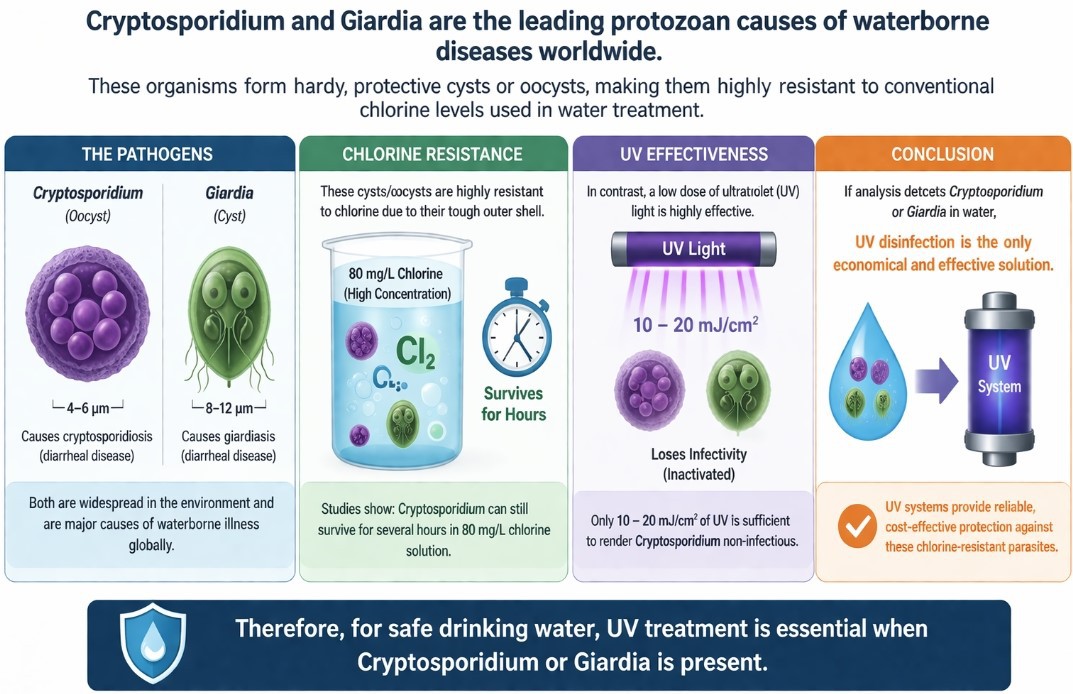
Cryptosporidium and Giardia lamblia are the main protozoan pathogens causing waterborne diseases worldwide. These organisms form oocysts or cysts with hard outer shells, making them highly resistant to conventional chlorine concentrations. Studies show that Cryptosporidium can survive several hours even in 80 mg/L chlorine solution, whereas only 10–20 mJ/cm² of UV is sufficient to inactivate it. Therefore, if laboratory analysis confirms the presence of these parasites, a UV system represents the only cost-effective and reliable solution.
4. Assessment of Water Quality Characteristics
4.1 Limits for Interfering Substances and Pre-Treatment Determination
Before considering the installation of a UV system, the following parameters must be evaluated. If any parameter exceeds the recommended limit, pre-treatment equipment is required:
|
Interfering Parameter |
Recommended Limit |
Interference Mechanism |
Pre-Treatment Recommendation |
|
Turbidity |
< 1 NTU |
Suspended particles create a "shadowing effect," allowing microorganisms to hide |
40-micron sediment filter |
|
Iron |
< 0.3 mg/L |
Forms reddish-brown deposits on quartz sleeves, blocking UV radiation |
Oxidation iron remover or manganese sand filter |
|
Hardness |
< 7 GPG |
Calcium and magnesium salts scale the quartz sleeve, reducing radiation intensity |
Water softener |
|
Total Suspended Solids (TSS) |
< 10 mg/L |
Physically shields the UV path |
Multi-media filter |
In addition to laboratory testing, household users can also use sensory cues to intuitively assess potential microbial risks. Based on water source risk, water quality testing, and sensory observations, the urgency of installing a UV system should be evaluated according to the household's specific circumstances.
5. Sensory Signals: How Household Users Can Intuitively Identify Potential Risks
Although bacteria are invisible to the naked eye, changes in water characteristics often indicate increasing microbial risks.
5.1 Odor Recognition and Microbial Association
- Rotten fish or earthy smell: Typically caused by algal blooms (e.g., cyanobacteria) in lakes or reservoirs. While odor compounds such as geosmin are usually non-toxic, they indicate organic pollution and potentially high microbial content.
- Rotten egg smell (hydrogen sulfide): May result from sulfate-reducing bacteria in low-oxygen environments, such as well bottoms or the ends of pipes. This suggests active microbial growth requiring disinfection intervention.
5.2 Visual Indicators and Physical Challenges
- Discolored water: Persistent red, yellow, or brown water may indicate excess iron/manganese or infiltration of surface runoff, all of which can significantly reduce UV system efficiency.
- Sticky films (biofilms): Gray or pink sticky films on faucet outlets or toilet tanks indicate bacterial biofilm formation. The presence of biofilm implies living bacteria in the plumbing; installing a UV system can interrupt subsequent bacterial replenishment.
6. Determining Installation Urgency for Specific Populations
For certain households, microbial safety is not merely a matter of comfort but of life safety.
6.1 Immunocompromised Individuals
Even trace opportunistic pathogens in drinking water may pose significant health risks to people with weak immune systems. Even if the water meets municipal standards, installing a terminal UV disinfection device is recommended to provide a reliable final barrier for drinking water safety.
6.2 Vulnerable Age Groups: Infants and Elderly
Infants have underdeveloped gut microbiota and weak kidney function, making them highly sensitive to dehydration caused by waterborne pathogens. Elderly individuals may have reduced gastric acid secretion, lowering natural defenses against ingested bacteria. If these household members are present, and the water source is from a well or aging pipes, the installation priority of a UV system should be "very high."
7. System Sizing and Engineering Considerations
If a UV system installation is decided, selecting the correct specifications is a critical engineering step to ensure effective operation.
7.1 Point of Entry (POE) vs. Point of Use (POU)
- Whole-House Point of Entry (POE): Installed at the main water supply entrance, it protects showers, laundry, and all taps. This is crucial to prevent inhalation of pathogenic bacteria through aerosols (e.g., Legionella). Typical POE systems need to support 10–12 GPM flow rates.
- Point of Use (POU): Usually installed under a kitchen sink, treating only drinking and cooking water. This is a cost-effective choice for users primarily concerned with gastrointestinal pathogens.
7.2 Flow Rate and Residence Time Constraints
As previously explained, UV disinfection effectiveness depends on the delivered UV dose, which is a function of photon exposure to microorganisms. If the selected system has insufficient flow capacity (e.g., a 2 GPM-rated device is used for whole-house supply), water passes through the UV chamber too quickly, and microorganisms receive an inadequate dose, preventing effective inactivation. Therefore, system sizing should always consider the maximum potential flow when all household taps operate simultaneously to ensure the required disinfection performance.
Conclusion
The high disinfection efficacy of UV water systems is built on a solid scientific foundation and has been thoroughly validated. However, actual performance is not determined by the product alone-it depends on the complexity of onsite water quality, operating conditions, and various environmental factors. Variations in water composition and operating conditions can affect disinfection efficiency. Optimal system performance requires careful adaptation to the installation environment.
To ensure maximum microbial inactivation, potential interfering factors must be identified and mitigated, and pre-treatment optimized for specific conditions. This is not a compromise of product performance but a scientific approach to enable the UV system to operate at its best, providing a robust and reliable barrier for household water safety.


