


Salt-based water softeners effectively reduce water hardness, but they also require a continuous supply of regenerant salt. In homes with high water hardness, heavy water consumption, or unstable softener operation, frequent regeneration can lead to higher salt consumption, greater rinse-water use, and increased maintenance costs.
ScaleDp offers a simple way to optimize the system:
Installed directly before a salt-based water softener, ScaleDp uses physical scale control to influence the crystallization and deposition behavior of hardness minerals. This can help the softener operate more consistently, extend the effective interval between regeneration cycles, and reduce salt and regeneration-water consumption.
ScaleDp does not require the existing softener to be replaced, nor does it require a blending or partial-softening system.
The recommended installation sequence is:
Main Water Inlet → Prefilter → ScaleDp → Salt-Based Water Softener → Whole-House Water Supply
How Can Scale Buildup Affect Water Softener Operation?
Before hard water reaches the resin bed, it must pass through the inlet pipework, flow passages, metering components, and control valve.
These parts are still exposed to untreated hard water. Over time, hardness minerals may form deposits on pipe walls, valve components, and narrow internal flow passages.
As mineral deposits accumulate, they may contribute to:
- Reduced inlet flow
- Restricted control-valve movement
- Inaccurate flow-meter readings
- Slower or incomplete brine draw
- Less effective backwashing and rinsing
- Uneven water distribution through the resin bed
- Premature deterioration in softened-water quality
When users notice that softened water does not last as long as expected, they may manually initiate regeneration, shorten the regeneration interval, or increase the salt dosage.
This means that a water softener may experience two different types of salt consumption:
|
Type of salt consumption |
Cause |
|
Essential salt consumption |
Salt required to regenerate resin after normal calcium and magnesium removal |
|
Avoidable additional salt consumption |
Premature or inefficient regeneration caused by scale, valve problems, poor brine draw, or unstable operation |
ScaleDp primarily helps address the second category while supporting more effective use of the resin and each regeneration cycle.
What Does ScaleDp Do Before the Water Softener?
ScaleDp uses DPSE physical scale-control technology. As water passes through its multi-alloy physical core, the technology is designed to influence the nucleation, crystal growth, aggregation, and surface-adhesion behavior of hardness minerals.
ScaleDp does not exchange calcium and magnesium for sodium, as a salt-based softener does. It also does not directly convert hard water into near-zero-hardness softened water.
Instead, ScaleDp changes how scale-forming minerals behave.
Untreated hardness minerals
Without treatment, hardness minerals are more likely to develop into dense, hard crystals that can attach firmly to pipes and equipment surfaces.
Hardness minerals after ScaleDp treatment
After passing through ScaleDp, the minerals are encouraged to remain more dispersed or form smaller, looser particles with a lower tendency to adhere to surfaces. More of these particles can continue moving with the water flow instead of becoming hard scale deposits.
ScaleDp positions DPSE as a physical scale-control technology that retains calcium and magnesium while reducing the formation of hard, adherent scale. It is not intended to replace ion-exchange softening.
Research into physical water-treatment methods also indicates that, under certain water-quality and operating conditions, physical treatment can influence calcium carbonate nucleation, crystal morphology, and surface deposition.
Actual performance can vary according to water chemistry, temperature, flow conditions, pipe materials, and system design.
How Can ScaleDp Help Extend Regeneration Intervals?
The salt-saving mechanism is not:
ScaleDp removes calcium and magnesium → the softener no longer requires salt
The actual mechanism is:
ScaleDp physical treatment
→ Reduced formation and adhesion of hard scale
→ Less mineral-deposit interference in valves, flow passages, and the resin system
→ More stable softener operation and regeneration
→ Longer effective operation between regeneration cycles
→ Fewer regeneration cycles
→ Reduced salt and rinse-water consumption
ScaleDp supports this process in four main ways.
1. Reducing Scale in Inlet Pipes and Control Valves
The control valve is one of the most important components of a water softener. It switches the system between service, backwash, brine draw, slow rinse, and fast rinse.
Hard deposits inside the control valve or its narrow flow passages may interfere with valve movement and water-flow stability.
Installing ScaleDp before the softener allows scale control to begin before hard water enters these components. This helps reduce the tendency of mineral deposits to interfere with the inlet passages and control valve.
2. Supporting a Stable Brine-Draw Process
During regeneration, the softener must draw brine from the salt tank into the resin vessel.
Scale buildup around the brine injector, nozzle, or related flow passages may result in:
- Slower brine draw
- Insufficient brine volume
- Abnormal water remaining in the brine tank
- Incomplete resin regeneration
- Reduced recovery of softening capacity
If the resin is not fully regenerated, the softening effect may decline earlier than expected, causing the system to initiate another regeneration cycle.
By reducing mineral deposition in these areas, ScaleDp can help maintain more stable brine draw, backwash, and rinse processes, allowing the salt used during each regeneration to be utilized more effectively.
3. Helping the Resin Bed Operate More Consistently
Resin performance depends not only on the amount of resin in the tank but also on stable water distribution, effective regeneration, and freedom from mineral deposits in the internal flow system.
Hard deposits in the distributor, resin bed, or internal water channels may contribute to channeling, local restriction, or incomplete use of the resin.
By influencing the crystallization and adhesion behavior of scale-forming minerals, ScaleDp helps reduce dense scale formation in these areas and supports more stable hydraulic conditions through the resin bed.
4. Reducing Unnecessary Early Regeneration
When softened-water performance becomes inconsistent, the user or control system may shorten the time between regeneration cycles.
If the decline is partly caused by scale deposits in the valve, flow passages, or resin system, increasing the regeneration frequency does not solve the underlying problem. It only increases salt and rinse-water consumption.
Through front-end physical scale control, ScaleDp helps the softener maintain a more stable treatment condition between regeneration cycles, reducing the likelihood of unnecessary early regeneration caused by scale-related interference.
Can ScaleDp Directly Reduce Water Softener Salt Consumption?
Under suitable water-quality, flow, and installation conditions, installing ScaleDp directly before a salt-based water softener can help extend the effective regeneration interval and reduce the number of regeneration cycles during normal operation.
Potential benefits include:
- Less frequent salt refilling
- Fewer regeneration cycles over the same period
- Lower regeneration-water consumption
- More stable control-valve and inlet-passage operation
- Longer-lasting softened-water performance
- Lower long-term maintenance pressure on the softening system
However, ScaleDp does not mean that a salt-based water softener can stop using salt entirely.
The softener still needs salt to regenerate its ion-exchange resin because ScaleDp does not remove all dissolved calcium and magnesium in the same way as ion exchange.
A more accurate product statement is:
ScaleDp uses front-end physical scale control to reduce mineral-deposit interference, helping the water softener make more effective use of its resin and regeneration cycles. This can extend regeneration intervals and reduce actual salt consumption.
Does Installing ScaleDp Require Changes to the Existing Softener System?
In most cases, no complex modification is required.
The recommended installation arrangement is:
Main Water Inlet → Prefilter → ScaleDp → Water Softener → Whole-House Pipework
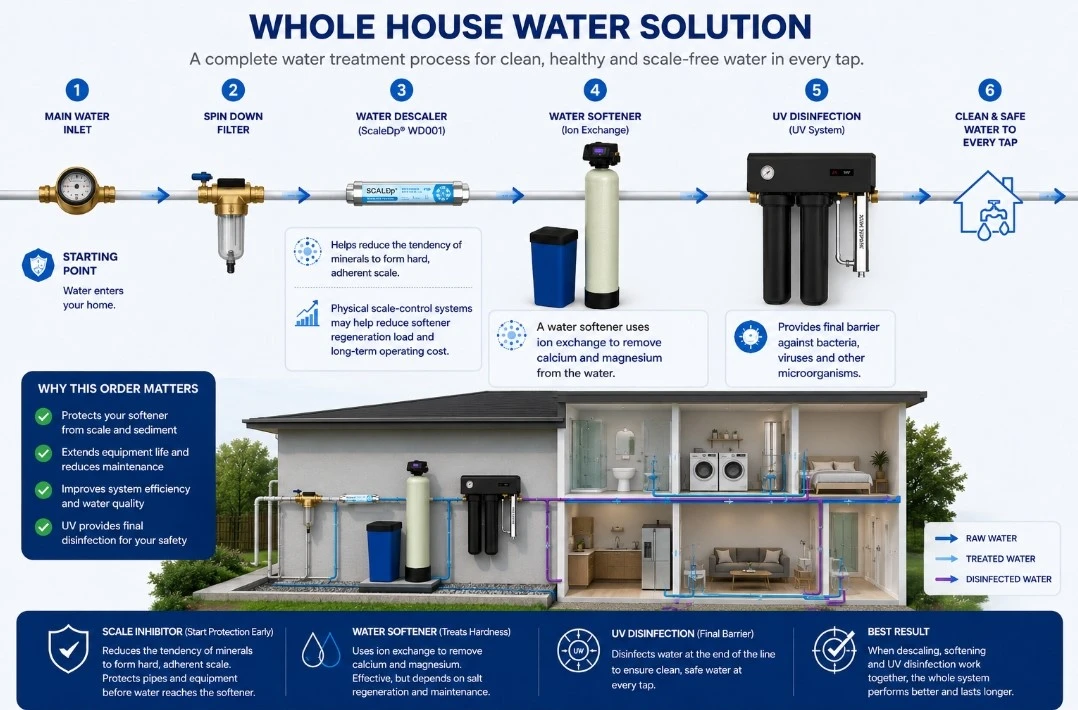
In this configuration:
- The prefilter captures sediment, rust, and larger suspended particles.
- ScaleDp provides physical scale control before the softener.
- The water softener continues to reduce hardness through ion exchange.
- The treated water is supplied to the water heater, showers, washing machine, and other household water outlets.
ScaleDp should be installed before the softener. If it is installed after the softener, it cannot treat the hard water entering the control valve, resin tank, and upstream flow passages, so its ability to support softener operation will be significantly reduced.
Important installation considerations include:
- Matching the ScaleDp model to the pipe size and peak flow rate
- Following the correct flow direction
- Keeping water pressure and temperature within the product's operating range
- Providing appropriate sediment pretreatment
- Confirming that the softener does not have continuous drainage, salt bridging, or valve failure
- Correctly setting the feedwater hardness and regeneration parameters
Which Water Softener Systems Can Benefit Most from ScaleDp?
Installing ScaleDp before the softener can be particularly valuable when:
- Feedwater hardness is high.
- The water has a strong scaling tendency.
- Salt consumption has gradually increased.
- Regeneration has become more frequent without a corresponding increase in water use.
- White mineral deposits are visible in inlet pipes, valves, or prefilters.
- The brine-draw process is inconsistent.
- Softened-water performance varies from one cycle to another.
- Manual regeneration is frequently required.
- The control valve or internal flow passages have previously required descaling.
- The owner wants to reduce both salt consumption and regeneration wastewater.
Similar symptoms can also result from incorrect hardness settings, contaminated resin, salt bridging, leaking valves, or mechanical failure.
ScaleDp should therefore be used as part of a complete system-optimization strategy, not as a substitute for proper inspection and maintenance.
How Can the Actual Salt-Saving Effect Be Verified?
The most reliable method is to compare actual operating data before and after installation rather than applying a universal salt-saving percentage.
Record the following before installation:
- Feedwater hardness
- Softened-water hardness
- Monthly household water consumption
- Salt dosage per regeneration
- Number of regeneration cycles per month
- Actual monthly salt usage
- Volume of water treated between regeneration cycles
- Any flow, brine-draw, or valve abnormalities
Record the same data after installation:
Keep the original softener model, resin capacity, hardness settings, and treated-water requirements unchanged as much as possible.
The comparison should focus on:
- Whether the regeneration interval becomes longer
- Whether more water is treated between regeneration cycles
- Whether the number of monthly regeneration cycles decreases
- Whether softened-water quality remains stable
- Whether actual monthly salt consumption decreases
- Whether mineral deposits in valves and pipework are reduced
Comparing the volume of water treated between regeneration cycles is more accurate than simply comparing the number of days between regenerations, because household water demand can change with seasons and daily habits.
A useful performance indicator is:
Salt consumption per unit of water = total salt used during the monitoring period ÷ total softened-water volume
Comparing this value under similar water-quality and water-demand conditions provides a clearer picture of the actual improvement.
Why Should a Fixed Salt-Saving Percentage Be Avoided?
The actual performance of ScaleDp can be influenced by:
- Feedwater hardness and alkalinity
- Calcium-to-magnesium ratio
- pH
- Water temperature
- Flow velocity
- Pipe diameter
- ScaleDp model selection
- Softener design and resin condition
- Iron, manganese, silica, and other water constituents
- Existing scale buildup in the system
Published research indicates that the effects of physical water treatment on calcium carbonate crystallization and deposition depend strongly on water chemistry and operating conditions.
The article can therefore state that ScaleDp helps extend regeneration intervals and reduce salt use, but it should not promise the same percentage reduction or regeneration period for every installation without corresponding test data.
ScaleDp and Water Softeners Perform Different Functions
|
Comparison |
ScaleDp Physical Water Descaler |
Salt-Based Water Softener |
|
Main function |
Influences mineral crystallization and deposition behavior |
Removes calcium and magnesium through ion exchange |
|
Directly reduces measured hardness |
No |
Yes |
|
Requires salt |
No |
Yes |
|
Requires regeneration |
No |
Yes |
|
Produces regeneration wastewater |
No |
Yes |
|
Role in a combined system |
Provides front-end scale control and supports stable softener operation |
Produces genuinely low-hardness softened water |
ScaleDp retains calcium and magnesium while reducing the tendency of hard scale to adhere. The softener removes hardness minerals to produce softened water.
Used together, the two technologies can provide both scale control and the benefits of genuine water softening.
Conclusion
Installing ScaleDp directly before a salt-based water softener can help address frequent regeneration, high salt consumption, and unnecessary regeneration-water use.
ScaleDp does not replace the water softener and does not directly turn hard water into soft water. Its DPSE physical scale-control technology influences the crystallization, aggregation, and deposition behavior of hardness minerals, helping reduce hard-scale interference in inlet pipes, control valves, brine injectors, distributors, and resin systems.
When properly selected, installed, and operated within suitable conditions, ScaleDp can help the water softener:
- Maintain more stable flow and valve operation
- Support more effective brine draw, backwashing, and rinsing
- Make fuller use of the resin and each regeneration cycle
- Extend the effective operating interval between regenerations
- Reduce unnecessary regeneration cycles
- Lower salt and regeneration-water consumption
The central conclusion is:
By providing physical scale control before the salt-based water softener, ScaleDp helps the system operate more consistently and efficiently. This can extend regeneration intervals and reduce actual salt consumption without replacing the existing softener or changing the whole-house water-supply arrangement.
References
- U.S. Environmental Protection Agency. Soften Water Without Wasting It: Guide to Selecting and Maintaining a Water-Efficient Water Softener.
- U.S. Environmental Protection Agency. WaterSense Labeled Homes Technical Sheet: Water Softeners.
- NSF. NSF/ANSI 44: Residential Cation Exchange Water Softeners.
- Boluda-Botella, N., et al. Analysis of Calcium Carbonate Scales in Water Distribution Systems and Influence of Electromagnetic Treatment. Water, 2024.
- Alimi, F., et al. Influence of Physical Treatment on Calcium Carbonate Precipitation and Scale Formation.
- ScaleDp. DPSE Technology and Physical Scale-Control Mechanism.


