
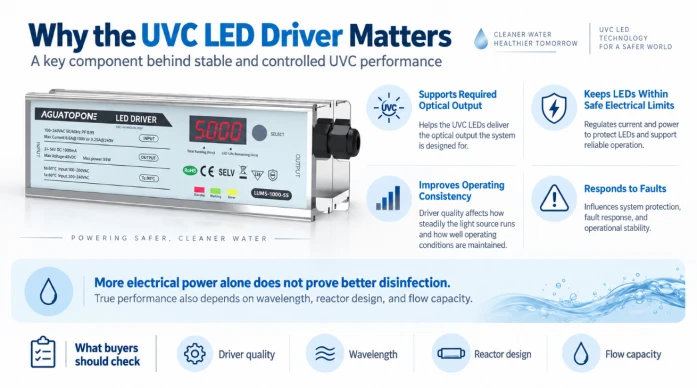
A UVC LED driver helps a water disinfection system produce the optical output its design requires while keeping the LEDs within suitable electrical limits. Its quality affects how consistently the light source operates, how it responds to faults, and whether the intended operating conditions can be maintained.
For buyers comparing systems, the driver deserves attention alongside wavelength, reactor design and flow capacity. Understanding its role also explains why increasing electrical power cannot, by itself, establish better disinfection performance.
Why UVC LED Need Controlled Current
UVC LED are semiconductor devices whose light output depends on forward current. Their electrical behaviour differs from that of a simple resistive load: a small change in applied voltage can produce a much larger change in current. Excessive current can damage an LED. Texas Instruments explains these relationships in its guidance on LED driver circuits.
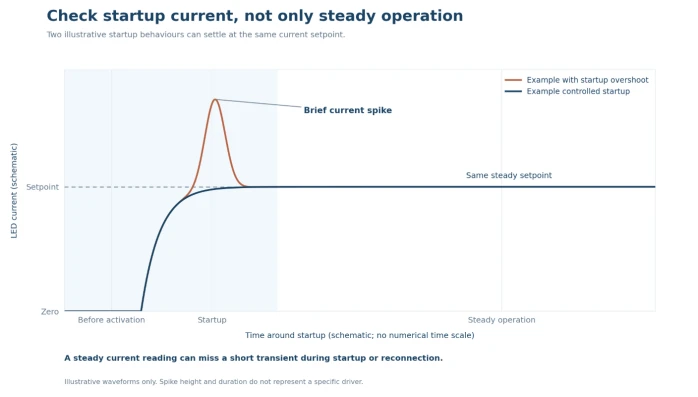
A constant current driver regulates the current delivered to the LED within its specified operating range. It adjusts its output voltage as needed, provided the supply and LED load remain compatible. This reduces current variation caused by changing supply voltage or LED forward voltage.
A device may therefore use a constant voltage adapter, such as a DC power supply, followed by an internal constant current circuit. The adapter label alone does not describe how the LED current is controlled.
How Driving Current Affects UVC Output
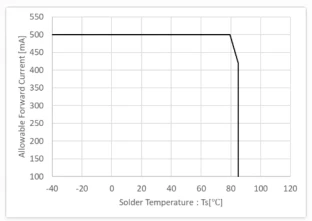
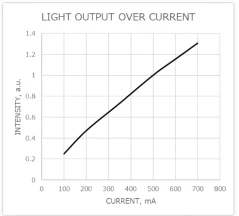
Increasing forward current can increase UVC optical output, but the relationship must be checked using the particular LED's performance curves and temperature conditions. Crystal IS publishes separate curves for optical output versus current and recommended current versus solder point temperature in its Klaran LA datasheet.
Three quantities should be distinguished when comparing water disinfection equipment:
- Electrical input power, usually expressed in watts, describes power consumed.
- UVC optical power, expressed in milliwatts or watts, describes emitted ultraviolet radiation.
- UV dose, commonly expressed in mJ/cm², describes ultraviolet energy delivered per unit area.
A driver influences the light source's output. The dose received by microorganisms also depends on the reactor's optical and hydraulic conditions. EPA guidance evaluates UV reactors using defined operating conditions, including flow, UV transmittance and light-source output. A wattage rating is therefore insufficient evidence of disinfection performance.
Current and Thermal Management Must Work Together
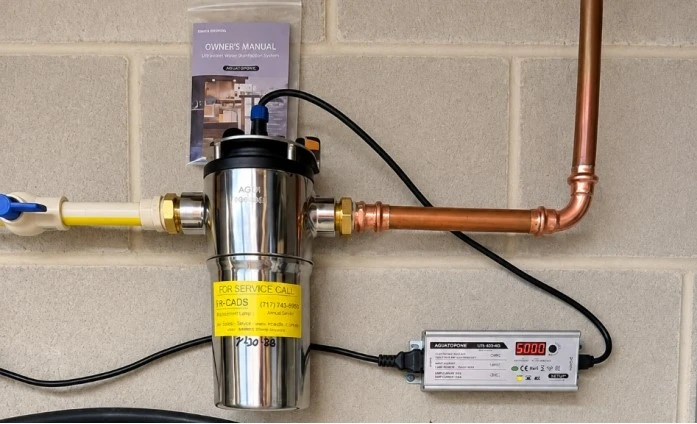
An operating UVC LED converts electrical energy into both radiation and heat. The temperature at its semiconductor junction depends on heat generation and the thermal path through the package, circuit board and cooling arrangement. Crystal IS identifies thermal management as a central requirement when designing disinfection systems.
Selecting a higher driving current requires reassessing that thermal path. Extra initial output may be accompanied by additional heat, and excessive temperature can undermine the intended output and service life.
Constant current regulation does not remove this heat. A system designer must match the driving conditions to the cooling capacity, including the warmest permitted installation conditions. Driver electronics also generate heat, so their location and efficiency deserve consideration.
For equipment that relies on water flow for cooling, operation without the required flow must follow the manufacturer's restrictions. Dry-operation limits are specific to the complete product.
Stable Current Does Not Mean Constant Optical Output
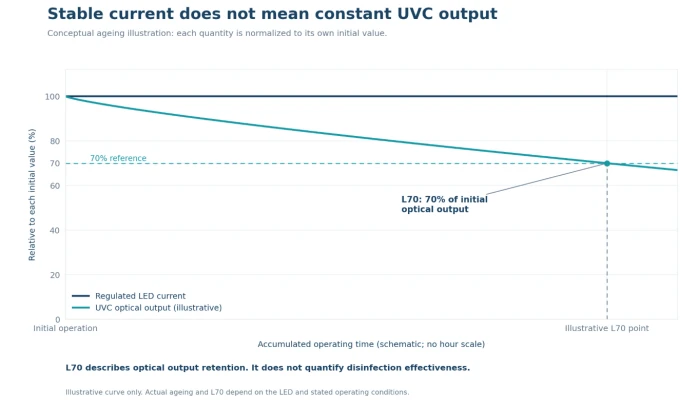
UVC LED output can decline with accumulated operating time even when current remains regulated. Temperature and material characteristics also affect performance. A driver can maintain the electrical setpoint while the light source delivers less radiation than it did when new.
L70 describes the time at which an LED optical output reaches 70% of its initial value under specified operating conditions.