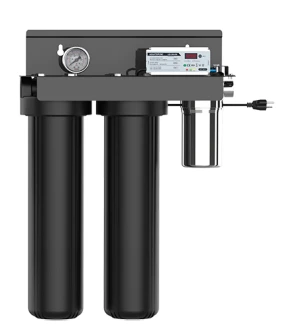

For roughly 20 years, our work in ultraviolet water disinfection has started with a straightforward goal: helping customers disinfect water safely. As more customers installed our UV disinfection equipment, their questions increasingly reached beyond the UV unit itself. What treatment should come before it? How should the equipment be protected? How would someone know when maintenance was due?
Those conversations helped shape our integrated water treatment system range at AGUA TOPONE. They encouraged us to consider the water entering the UV unit, the equipment around it, and the experience of the person looking after it.
Our standalone UV disinfection products remain an important part of our business. Integrated systems extend that offering, giving customers another way to incorporate UV disinfection into their water treatment projects.
The questions that started upstream
Our early focus was the UV disinfection unit. In customer discussions, however, the conversation often moved to pretreatment. Customers wanted to understand what should happen to their water before it reached the disinfection stage, and whether we could help provide that part of the system.
There was a practical reason for these questions. UV equipment needs suitable incoming water conditions. Large particles, excessive turbidity, and material collecting on the quartz sleeve were among the concerns we discussed with customers. These issues made the condition of the incoming water an important part of the conversation about disinfection.
For customers, that meant selecting a UV unit was one part of a larger decision. They also needed to consider how upstream treatment would prepare the water for it. For us, the recurring questions showed that customers were looking for guidance on how different parts of a treatment system should work together.
That demand became the starting point for a product line combining pretreatment with UV disinfection.
Bringing pretreatment and UV into one system
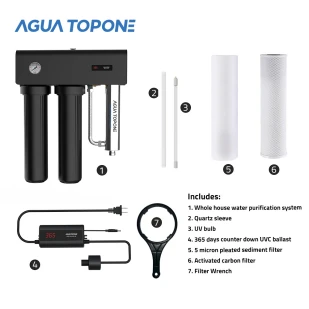
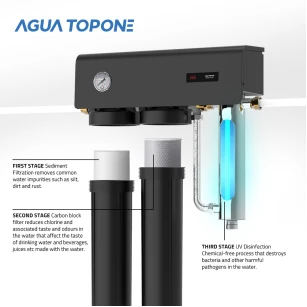
When discussing these integrated treatment arrangements with customers, our recommendation was to position UV after the preceding treatment stages. This gave us a natural starting point for system development: consider the upstream preparation and the UV unit together.
The aim was to offer a coordinated arrangement for customers who wanted both. A standalone UV unit could still serve customers with existing pretreatment or their own system designs. An integrated configuration gave other customers an additional option when planning a new installation.
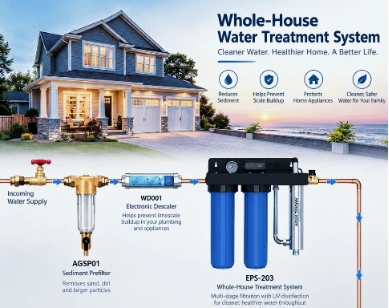
This distinction matters because different projects begin in different places. An installer adding UV to an established treatment line faces a different task from a distributor selecting an integrated product for a new customer. Extending our range allowed us to address both kinds of conversation.
It also broadened the questions guiding product development. Alongside the disinfection equipment, we began paying closer attention to how the assembled system would be protected and how its maintenance needs would be communicated.
Protection was an early design priority
When we developed our early integrated systems, our thinking was practical. We wanted to provide protection for the equipment and make it easier for customers to understand when attention was needed.
One response was to add a protective cover. The cover addressed a question that becomes particularly relevant once individual components are brought together: how should the installed assembly be protected in its intended location?
The importance of that question continues throughout our product development. Customers need to consider the installation environment when selecting equipment. A protective enclosure is one part of that discussion, alongside the requirements of the components inside it.
For our team, including a cover in the early system design reflected a growing focus on what happened after delivery. The equipment would become part of a customer's property or project, where its installation conditions would matter throughout its use.
Making lamp maintenance easier to plan
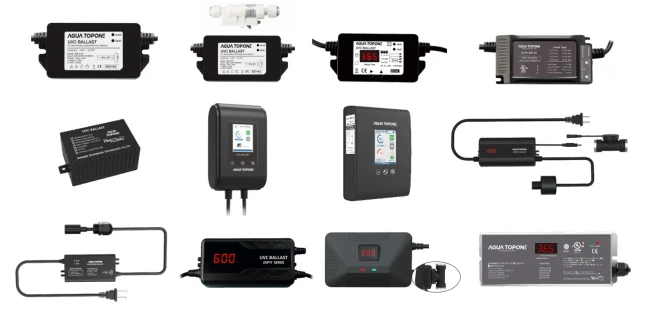
Another early decision was to equip the system with a countdown ballast. This early configuration included a 365-day countdown, together with reminders or alarms associated with lamp replacement and lamp faults.
The purpose was to help customers recognize when the lamp needed attention. A scheduled maintenance task is easier to manage when the equipment provides a clear reminder, especially for someone who does not work with UV systems every day.
This also gives installers and service teams something concrete to explain at handover: what the indicator means, what to do when a reminder appears, and whom to contact for the appropriate replacement part.
A maintenance reminder has a specific role. It helps organize servicing; it should be understood according to the functions of the installed controller. Clear explanations of those functions are part of making the product easier to use.
Learning from equipment already in use
As more of our systems entered service, we received more feedback about their day-to-day operation. One recurring example was customers asking why the UV lamp remained continuously on, including during periods when no water was being used.
That question moved the discussion beyond whether the system could disinfect water. Customers were also thinking about how the equipment behaved between periods of use, how clearly its operating condition could be understood, and how easily routine service could be planned.
This feedback did not change the role of conventional UV lamp systems in our range. Instead, it introduced another set of product-development questions. Could a different light-source option respond more directly to water use? How should the system communicate its operating status? And when maintenance became necessary, could the relevant component be serviced without replacing more of the equipment than required?
These questions became increasingly important as we continued developing our integrated product range.
For distributors and installers, they also reflected the realities of supporting equipment after installation. Explaining an indicator, arranging replacement parts, protecting the equipment in its installation environment, and helping customers understand normal operating behavior can all become part of the long-term product relationship.
From integrated systems to the next design question
Our integrated UV water treatment systems grew from questions customers were already asking about pretreatment, equipment protection, and maintenance. Bringing these elements together gave customers another option alongside our standalone UV disinfection products.
Once those systems were in use, however, the conversation continued to develop. Customers were no longer asking only what treatment should come before the UV unit. They were also asking how the UV system should behave during everyday use and how its operating and maintenance information could be made easier to understand.
As UV LED technology developed, these questions became especially relevant. Customers began showing interest in a mercury-free light source and the possibility of on-demand operation. For our team, this raised a broader question: how could UV LED be incorporated into an integrated water treatment system without treating it as simply a replacement for a conventional lamp?
We needed to consider how the system would indicate operating status, how maintenance timing would be communicated, whether the UV LED module could be serviced independently, and how the complete assembly should be protected in different installation environments.
Those questions became the starting point for the next stage of our integrated system development.
In Part Two, Designing UVC LED Water Treatment Systems for Use and Maintenance, we look at how customer feedback influenced the development of our GPS and VPS systems, including on-demand operation, status information, replaceable UV LED modules, and installation protection.
If you are planning a UV water treatment project, share your water source, intended flow rate, existing pretreatment, and installation conditions with our team. These details provide a useful starting point for discussing whether a standalone or integrated configuration is more appropriate for your project.