


In ultraviolet (UV) water treatment, engineers, facility managers, and system buyers frequently ask an important question:
After bacteria have been inactivated by UV disinfection, is it still possible for them to regain their activity?
Scientifically, the answer is yes. Under certain conditions, bacteria exposed to a sub-lethal UV dose may repair UV-induced DNA damage and regain their ability to reproduce.
However, this does not mean that UV disinfection is unreliable. On the contrary, it highlights one of the most important engineering principles in UV system design: a sufficient and validated UV dose (fluence) must be delivered to ensure that DNA damage exceeds the microorganisms' natural repair capacity.
To understand why UV dose, rather than lamp wattage alone, determines whether bacteria are temporarily suppressed or permanently inactivated, we need to examine four key aspects: how UV-C damages bacteria, how bacteria attempt to repair their DNA, how UV fluence prevents recovery, and how the hydraulic design of a UV reactor ensures that every drop of water receives the required UV dose.
Scope Note: This article focuses specifically on bacteria. Bacterial DNA repair mechanisms cannot be directly applied to viruses or protozoa, such as Cryptosporidium and Giardia, because they have fundamentally different biological structures and inactivation kinetics.
1. How Does UV-C Inactivate Bacteria, and Why Can They Still Recover?
Unlike chemical disinfectants such as chlorine and ozone, which work through oxidation and can damage cell structures, UV disinfection targets the genetic material of microorganisms.
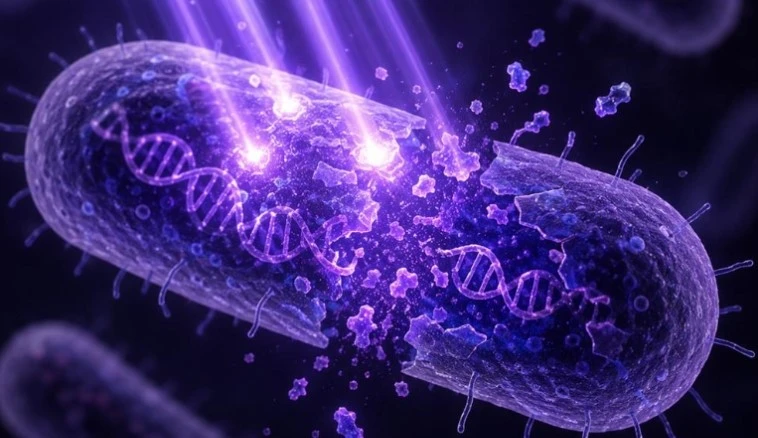
When bacteria are exposed to germicidal ultraviolet radiation, primarily in the UV-C spectrum (200–280 nm), UV photons penetrate the cell wall and are absorbed directly by nucleic acids.
The absorbed energy causes abnormal covalent bonds to form between adjacent pyrimidine bases along the DNA strand, creating lesions known as Cyclobutane Pyrimidine Dimers (CPDs).
When DNA replication enzymes encounter these dimers, the reading and replication of genetic information are disrupted. Therefore, even if the outer cell membrane remains physically intact after the bacteria leave the UV chamber, they cannot continue reproducing, forming colonies, or causing infections if their DNA replication is effectively blocked.
There is, however, one important detail:
Blocked DNA replication does not necessarily mean that the damage is permanent.
Because the bacterial cell itself may remain structurally intact, certain bacteria possess evolved enzymatic systems capable of repairing or removing UV-induced DNA damage.
Whether bacteria remain inactivated or have the potential to recover depends on three factors:
- The initial density of DNA damage.
- The DNA repair capacity of the bacterial strain.
- Environmental conditions after UV treatment.
2. How Do Bacteria Attempt to Recover? Photoreactivation vs. Dark Repair
Bacteria are not entirely passive after UV exposure.
Depending on the bacterial species and their subsequent environment, they may activate two primary DNA repair mechanisms:
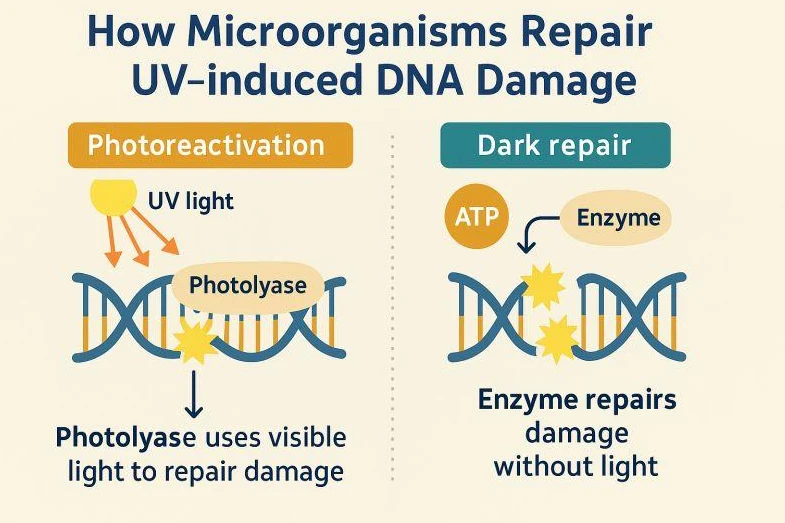
- Photoreactivation: a light-dependent repair mechanism.
- Dark repair: a light-independent repair mechanism.
2.1 Photoreactivation: A Light-Driven Repair Mechanism
Photoreactivation is a rapid, light-dependent enzymatic repair process.
Certain bacteria can produce a specialized enzyme called photolyase.
When UV-treated bacteria are subsequently exposed to near-UV or visible blue light, typically within the 300–500 nm wavelength range, photolyase absorbs the light energy and directly breaks the abnormal CPD bonds, restoring the DNA bases to their original configuration.
Real-World Risk Scenarios:
If UV-disinfected water is:
Discharged directly into an open basin or pond; Stored in a transparent plastic water tank; Transported through pipes exposed to direct sunlight;
Ambient light may promote photoreactivation within just a few hours, allowing bacteria that appeared to be inactivated to regain their ability to reproduce.
2.2 Dark Repair: A Light-Independent DNA Repair Mechanism
Even when treated water is stored in opaque pipes, not all DNA repair mechanisms are eliminated.
Some bacteria can also use Nucleotide Excision Repair (NER), a multi-enzyme repair process that does not require light.
This mechanism generally involves four steps:
- Scan & Recognize: Enzymes detect structural distortions in the DNA double helix caused by UV-induced dimers.
- Excise: Endonucleases remove the short DNA segment containing the damage.
- Resynthesize: DNA polymerase synthesizes a new DNA segment using the intact complementary strand as a template.
- Seal: DNA ligase reconnects the newly synthesized segment to the DNA backbone.
Because NER requires metabolic energy and multiple enzymatic steps rather than direct light energy, dark repair is generally much slower than photoreactivation and has more limited repair capacity.
Under many controlled experimental conditions, dark repair has been found to be very limited or even undetectable.
From an engineering perspective, the key conclusion is clear:
Bacterial reactivation is a conditional risk, and simply preventing light exposure cannot replace the need for an adequate UV disinfection dose.
Photoreactivation vs. Dark Repair: Key Differences
|
Comparison |
Photoreactivation (Light Repair) |
Dark Repair (NER) |
|
Trigger Condition |
Requires near-UV or visible light (300–500 nm) |
Light-independent; can occur in dark pipes or tanks |
|
Core Mechanism |
Photolyase uses light energy to directly break CPD bonds |
Enzymatic scanning, excision, template-based DNA synthesis, and sealing |
|
Speed & Extent |
Relatively fast; detectable recovery may occur within hours under light exposure |
Slower and energy-intensive; generally limited or even undetectable |
|
High-Risk Scenarios |
Transparent storage tanks, open reservoirs, and sunlit pipelines |
Warm, nutrient-containing dark pipelines with extended water residence times |
|
Primary Engineering Defense |
Sufficient UV dose + light-shielded storage |
Sufficient UV dose to produce DNA damage beyond the cell's repair capacity |
3. Crossing the Point of No Return: How Does UV Dose Prevent Bacterial DNA Repair?
If bacteria possess natural DNA repair mechanisms, how can UV disinfection achieve reliable and lasting inactivation?
The answer lies in:
Delivering a sufficient UV dose to push DNA damage beyond the bacteria's natural repair capacity.
Technically, UV dose, also known as UV fluence, measures the total germicidal UV energy delivered per unit area. It is expressed in millijoules per square centimeter (mJ/cm²).
Under ideal and uniform irradiation conditions, the relationship can be expressed as:
UV Dose (mJ/cm²) = UV Intensity (mW/cm²) × Exposure Time (seconds)
For example:
2 mW/cm² × 20 s = 40 mJ/cm²
However, in a real flow-through UV reactor, water does not move as a uniform body.
Individual microorganisms travel along different flow paths, at different velocities and at varying distances from the quartz sleeve surrounding the UV lamp.
This means that an actual UV reactor delivers a dose distribution, rather than one perfectly uniform UV dose to every microorganism.
Why Can Higher UV Fluence Prevent Bacterial Recovery?
Bacterial DNA repair enzymes have a finite repair capacity.
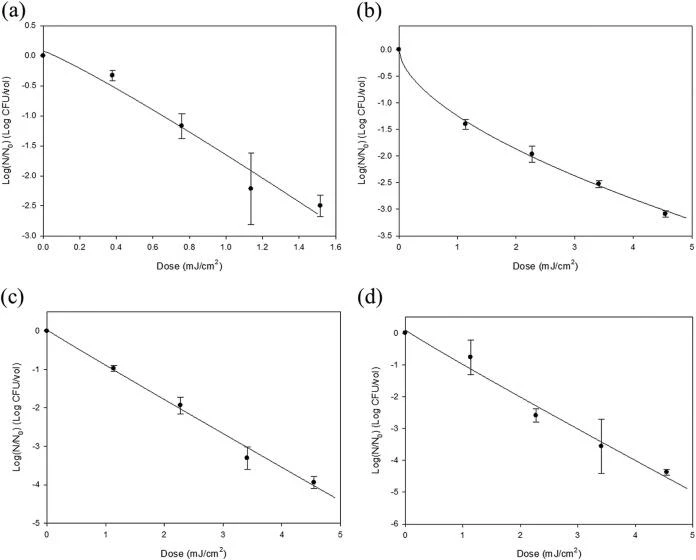
At a low UV dose, only a relatively small number of DNA dimers may form. These lesions can be more easily repaired through photolyase or NER mechanisms.
As UV fluence increases, DNA dimers accumulate more densely across the DNA double helix. At certain UV wavelengths, DNA repair proteins themselves may also be damaged.
Once the density of DNA damage exceeds a critical threshold, the bacterial repair machinery becomes overwhelmed and can no longer reconstruct a functional genome.
Experimental Evidence: A 2012 E. coli Study
Researchers investigated photoreactivation in two plasmid-bearing Escherichia coli strains under different UV doses.
After receiving a relatively low UV dose of just 5 mJ/cm², followed by four hours under photoreactivating light conditions, approximately 1% and 46% of the two strains successfully recovered their activity, respectively.
However, when the UV dose was increased to 15, 25, 40, and 80 mJ/cm² under the same experimental protocol, photoreactivation decreased to virtually negligible levels.
Engineering Implications:
Evaluating a UV system solely based on its immediate inactivation performance at a minimum UV dose can be misleading.
A reliable disinfection design must ensure that the delivered UV dose is sufficiently high to effectively suppress post-treatment bacterial reactivation.
4. Why Is There No Universal UV Dose? Three Factors That Affect the Bacterial Repair Threshold
Although increasing UV fluence can effectively suppress bacterial recovery, there is no single fixed dose that completely eliminates the possibility of reactivation across all microorganisms and applications.
The actual UV dose required is influenced by three biological and operational factors.
1. Differences in Resistance Among Bacterial Species and Strains
UV sensitivity and DNA repair efficiency vary considerably between different bacterial genera. Even different strains of the same bacterial species may respond differently to UV exposure.
A 2023 study using a flow-through UV-LED reactor demonstrated that when post-treatment bacterial recovery was included in performance calculations, the UV dose required to consistently achieve 4-log (99.99%) inactivation of E. coli increased by 18% to 160%, depending on the specific strain tested.
2. Germicidal UV Wavelength
Different UV wavelengths interact differently with microbial DNA and cellular proteins.
Traditional low-pressure mercury lamps primarily emit UV radiation at 254 nm, while emerging UV-LED technology allows manufacturers to select different target wavelengths.
For example, one comparative study found that, under its test conditions, 280 nm UV-LED irradiation suppressed E. coli reactivation more effectively than the other tested light sources.
This may be because the wavelength can damage not only bacterial DNA but also DNA repair enzymes.
3. Downstream Application and Storage Conditions
How treated water is stored and used after leaving the UV reactor also changes the risk of bacterial recovery.
For example:
In point-of-use drinking water systems where water is consumed immediately, bacteria have very limited time to recover after treatment.
For process water that requires long-term storage, especially in warm, sunlit, or transparent tanks, a greater safety margin in UV dose design may be necessary.
For UV system designers and equipment buyers, the practical question is:
Can the UV reactor still guarantee the target log reduction when realistic downstream storage and bacterial recovery conditions are taken into account?
5. Beyond Lamp Wattage: Why Reactor Engineering Determines the Actual UV Dose
A common mistake when purchasing UV disinfection equipment is comparing different UV sterilizers based solely on lamp wattage (W).
In reality, even a system equipped with a high-wattage lamp may deliver an insufficient UV dose if the reactor chamber is poorly designed or the incoming water quality is unsuitable.
Whether bacteria receive enough UV energy inside the reactor to prevent DNA repair depends on four interconnected engineering factors.
|
System Parameter |
Impact on Actual UV Dose |
Practical Engineering Solution |
|
1. UV Transmittance (UVT) |
Dissolved organic matter, iron, and water color absorb UV photons, reducing the penetration of germicidal energy into the water. |
Test the source-water UVT before system selection. Use activated carbon or iron removal pre-treatment to improve water quality, or select a higher-capacity reactor for low-UVT water. |
|
2. Flow Rate & Reactor Hydraulics |
Excessive flow reduces water residence time. Poor internal flow distribution may create hydraulic short-circuiting, allowing some microorganisms to receive significantly less UV energy than the average dose. |
Do not exceed the rated flow corresponding to the target UV dose, such as 30 or 40 mJ/cm². Select reactors with optimized hydraulic flow paths. |
|
3. Suspended Solids (Turbidity) |
Particles scatter UV light and create a shielding effect, preventing bacteria embedded within particles from receiving sufficient UV exposure. |
Install an appropriate pre-filtration system upstream of the UV reactor, typically including a 5-micron sediment filter. |
|
4. Quartz Sleeve Fouling & Lamp Aging |
Mineral scale or biofilm on the quartz sleeve blocks UV transmission, while UV lamp intensity naturally decreases over operating hours. |
Consider UV dose at End of Lamp Life (EOLL) during system selection. Clean quartz sleeves regularly and replace lamps according to the recommended maintenance schedule. |
Conclusion
Effective UV disinfection is never simply about exposing water to ultraviolet light.
Reliable UV disinfection requires delivering a sufficient and validated UV dose capable of preventing bacterial DNA repair, under controlled operating conditions.
For UV system designers, equipment manufacturers, and buyers, understanding the relationship between UV dose, reactor hydraulics, water quality, and downstream storage conditions is essential to ensuring reliable long-term disinfection performance.


