


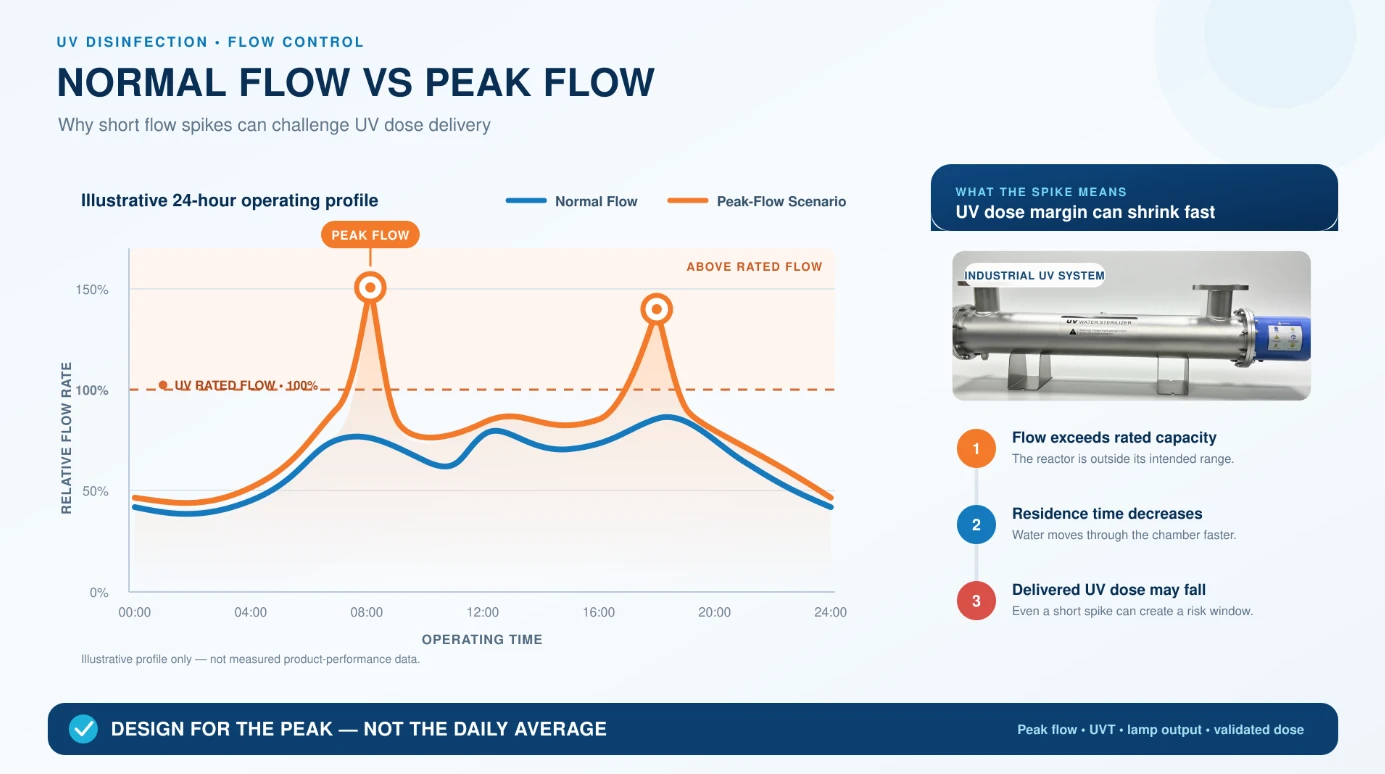
During hotel demand peaks, centralized cleaning in food-processing plants, filling-line start-up, or simultaneous operation of multiple pieces of equipment, the instantaneous flow rate may rise far above its normal average.
The UV system may remain powered on and the controller may show no lamp fault, yet water may already be passing through the reactor faster than the validated operating range allows. The real question is not whether the UV lamp is working, but whether every portion of the water is still receiving the required UV dose.
A UV system should therefore not be sized for average flow alone. It must maintain the required disinfection performance when maximum instantaneous flow, minimum actual UV transmittance (UVT), lamp aging and other unfavorable conditions occur together.
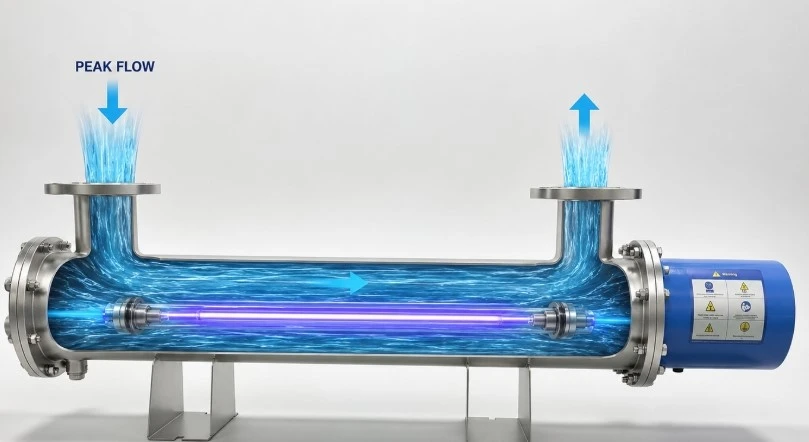
Why Does Peak Flow Affect UV Disinfection?
UV disinfection works only when microorganisms absorb sufficient ultraviolet energy while passing through the reactor. In simplified terms, UV dose can be expressed as:
UV Dose (mJ/cm²) ≈ UV Intensity (mW/cm²) × Exposure Time (s)
The average hydraulic retention time is related to the flow rate:
Retention Time ≈ Effective Reactor Volume ÷ Flow Rate
With reactor volume and UV output unchanged, a higher flow rate usually shortens the time water spends inside the reactor and may reduce the delivered UV dose.
The UK Drinking Water Inspectorate states that UV dose depends on irradiance and the time water remains within the reactor. The manufacturer's specified maximum design flow must therefore not be exceeded.
Source: UK DWI UV Disinfection Guidance
In a real UV reactor, however, it is not accurate to assume that a 40% increase in flow will always produce a 40% reduction in UV dose. Hydraulic distribution, turbulence, lamp position, reactor geometry and the different flow paths through the chamber all influence the final dose.
Engineering projects should therefore rely on a validated Reduction Equivalent Dose (RED), rather than on theoretical calculations alone.
For example, suppose a UV reactor has been validated under the following conditions:
- Maximum flow rate: 10 m³/h
- Minimum UVT: 85%
- Validated UV dose: 40 mJ/cm²
- UV intensity maintained above the specified setpoint
If the actual peak flow reaches 14 m³/h, the reactor is operating outside its validated range. The remaining UV dose cannot be determined reliably by simple extrapolation; the defensible conclusion is that the original validation data no longer guarantee disinfection performance.
Short-Duration Flow Peaks Cannot Be Ignored
Some operators assume that a peak lasting only a few minutes will have little effect on overall water quality. However, microbial disinfection is not assessed on the basis of an average daily dose.
Even if flow exceeds the reactor's capacity for only one minute, some water may receive an insufficient UV dose before entering a storage tank, production line or distribution network.
For drinking water, food and beverage production, pharmaceutical manufacturing and other microbiologically sensitive applications, even a short period of underdosing should be treated as a system risk.
The challenge can be greater in surface-water, rainwater and wastewater applications because peak flow may coincide with higher turbidity, increased suspended solids or reduced UVT. The system then faces two problems at the same time:
- Faster water movement reduces exposure time.
- Increased UV absorption reduces the effective UV intensity within the water.
This combination is more difficult to manage than a flow increase alone.
How Should a UV System Respond to Peak Flow?
1. Measure the Actual Peak Flow
A UV system should not be selected by simply dividing total daily water consumption by 24 hours. The relevant design value is the maximum instantaneous flow that may pass through the UV reactor.
Peak flow may be caused by:
- Multiple water outlets opening simultaneously
- Pump start-up or pump changeover
- Rapid storage-tank replenishment
- CIP cleaning and equipment rinsing
- Simultaneous filling-line operation
- Filter backwashing
- Production shift changes
- Rainy-season or peak wastewater flows
For commercial and industrial projects, the preferred approach is to use a flow meter or data logger to record the actual flow profile over a representative period, then compare the results with the pump's maximum output capacity.
Pump-rated flow or average water consumption alone may fail to reveal the true peak flow through the UV reactor.
2. Select the UV System for the Worst-Case Combination
A UV system's rated flow is not independent of operating conditions. At minimum, system selection should consider:
- Maximum instantaneous flow
- Required UV dose
- Minimum actual UVT
- Lamp output at the end of lamp life
- Expected quartz-sleeve fouling
- Pressure loss at peak flow
- Target microorganisms
The same UV reactor may have substantially different maximum treatment capacities at 90% UVT and 70% UVT.
A datasheet stating "20 m³/h" is therefore insufficient unless it also specifies the corresponding UVT, target UV dose and operating conditions.
For some drinking-water applications, NSF/ANSI 55 Class A systems use a UV dose equivalent to at least 40 mJ/cm² as an important performance requirement. However, this value should not be applied automatically to every project. The final required dose must be determined according to source-water risk, target microorganisms and applicable local regulations.
Source: Health Canada Technical Document
3. Dynamically Adjust UV Output Within the Validated Range
For systems with frequent flow fluctuations, flow-paced control can be used to match UV output to demand.
When the flow rate increases, the controller may:
- Increase lamp power
- Activate additional lamp banks
- Start additional UVC LED modules
When flow decreases, the system can reduce output to avoid unnecessary energy consumption.
However, variable-power control cannot expand reactor capacity indefinitely. Even with the lamps at maximum power, the required dose may not be guaranteed once flow exceeds the validated maximum.
The U.S. EPA states that UV dose monitoring should incorporate flow rate, UV intensity and lamp status. Some calculated-dose systems may also use UVT and lamp-power data.
Source: U.S. EPA Ultraviolet Disinfection Guidance Manual
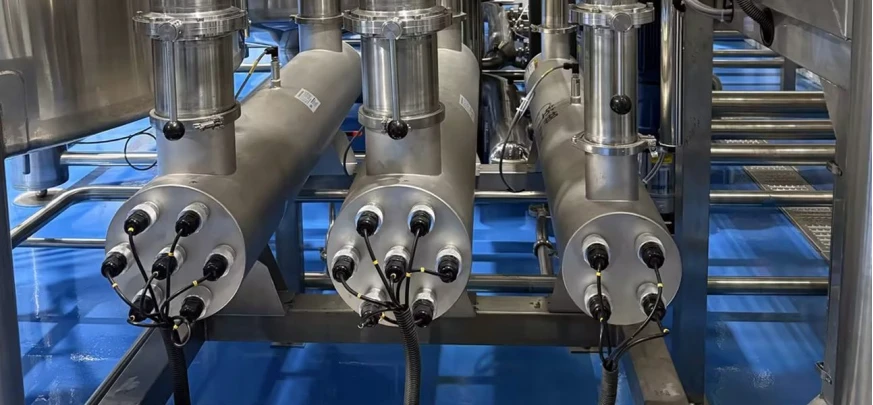
4. Use Multiple UV Reactors in a Staged Parallel Configuration
For commercial and industrial projects with large flow variations, staged parallel UV reactors can offer greater flexibility than one oversized reactor.
For example:
- One reactor operates during low-flow periods.
- A second reactor starts when flow increases.
- Multiple reactors operate simultaneously during peak demand.
- One reactor is retained as a standby unit.
This arrangement keeps each reactor within its validated flow range while reducing unnecessary energy use during low-flow periods.
Parallel systems, however, require careful flow balancing. If branch resistance differs, one reactor may receive excessive flow while another receives too little.
The pipework should therefore be designed with suitable flow meters, balancing valves or automatic control valves.
5. Reduce Peak Flow with a Buffer Tank or Flow-Control Equipment
When a high peak lasts only briefly, a buffer tank may be installed upstream of the UV system. A variable-frequency pump can then feed the reactor at a more stable flow rate.
Other flow-control options include:
- Flow restrictors
- Automatic regulating valves
- Variable-frequency pumps
- Pressure-control devices
These devices help prevent flow from exceeding the UV system's treatment limit.
UV provides no residual disinfection. If a storage tank is installed after the reactor, disinfected water may still be recontaminated during storage.
The tank should therefore be hygienically designed, regularly inspected and cleaned. In higher-risk projects, the final UV stage can be installed after the storage tank and before the point of use.
The UK DWI also notes that UV does not provide a disinfectant residual, making hygiene management within storage and distribution systems particularly important.
Source: UK DWI UV Disinfection Guidance
How Should Different Peak-Flow Solutions Be Selected?
Selection should reflect peak duration, the magnitude and frequency of flow swings, accompanying water-quality changes, continuity requirements and budget. Short, occasional peaks may be managed with buffering or flow limitation; frequent fluctuations may suit flow-paced control; and wide turndown or redundancy requirements may favor staged parallel reactors. In every case, interlocks should prevent water treated outside the validated range from reaching downstream users.
|
Solution |
Most Suitable Applications |
Key Considerations |
|
Larger-capacity UV system |
Projects with a clearly defined peak flow and a simple system layout |
Rated flow must be confirmed at the minimum UVT and required UV dose |
|
Variable-power control |
Commercial and industrial systems with frequent flow changes |
Output can only be adjusted within the validated operating range |
|
Multiple reactors in parallel |
Systems with a wide flow range or high continuous-supply requirements |
Flow must be balanced between all parallel branches |
|
Upstream buffer tank |
High peaks that last for relatively short periods |
Tank hygiene and downstream pumping flow must be controlled |
|
Flow restriction or variable-frequency pumping |
Projects that can accept limits on instantaneous water delivery |
May affect outlet pressure or production speed |
|
Automatic shutoff or recirculation |
High-risk drinking-water, food and pharmaceutical applications |
Alarm and failure-response logic must be designed in advance |
What Should Buyers Confirm with a UV System Supplier?
Buyers should ask more than, "How many cubic metres per hour can this system treat?" They should also confirm:
- What UV dose is delivered at the rated flow?
- Under what UVT condition was the rated flow determined?
- Does the performance data account for lamp aging and quartz-sleeve fouling?
- What are the validated minimum and maximum flow rates?
- If flow exceeds the validated limit, will the system trigger an alarm, close a valve, recirculate the water or continue supplying it?
- Does the controller monitor flow, UV intensity, UVT and validated dose in real time?
- What is the pressure loss at peak flow?
- Is a standby reactor required during maintenance or lamp failure?
If a supplier provides only lamp wattage and cannot specify the target UV dose, UVT conditions or maximum validated flow, the power rating alone does not demonstrate reliable peak-flow performance.
Conclusion
Managing peak flow correctly requires more than simply increasing lamp power. It calls for a complete control strategy:
Measure the actual peak flow, select the system for worst-case water conditions, adjust UV output dynamically within the validated range, and use parallel reactors, buffer storage, flow limitation and automatic interlocks to prevent underdosed water from reaching the downstream system.
When evaluating a UV project, Agua Topone recommends that customers provide the maximum instantaneous flow, minimum UVT, relevant water-quality data, required UV dose and actual operating pattern.
Only by assessing these conditions together can the designer determine whether the project needs a larger single reactor, staged parallel reactors, or a complete UV solution with flow control and automatic safety interlocks.
A UV system is not reliable merely because its lamps remain illuminated under average operating conditions. Reliability means that every portion of water still receives the required UV dose during the busiest and most unfavorable conditions.


