


In the post-pandemic era, safety has become a key word in daily life and the business world.
Taking "water safety" as an example, in the face of bacteria, viruses, molds, pathogens such as new coronavirus, cholera virus, etc.UV systems are safer, faster and more convenient than traditional chemical disinfection methods (such as chlorine).
UV systems, which avoid chemical additives and are easier to install, are becoming more popular.
So, what if we buy a UV system with advanced technology and efficient work?
1. Getting Started: Choose Medium Voltage or Low Voltage?
What kind of purpose you have, what is the flow rate of the water you need to treat, and what kind of UV system you choose.
According to the different UV lamps, UV systems can be divided into two types: low pressure and medium pressure.
Low pressure high output lamp, emitting 254 nanometers (nm) ultraviolet light;
Medium pressure high output lamp that emits UV light from 200 to 600 nanometers.
Low voltage lamps are more suitable for residential applications, while medium voltage models are suitable for large commercial facilities, municipal systems.
And compared to low pressure lamps, medium pressure UV systems have 4 advantages:
The sterilization output wavelength is wider and the disinfection efficiency is higher;
Obstruct the repair mechanism of microorganisms, and disinfect more thoroughly;
Built-in "light amplification" mechanism, more energy saving
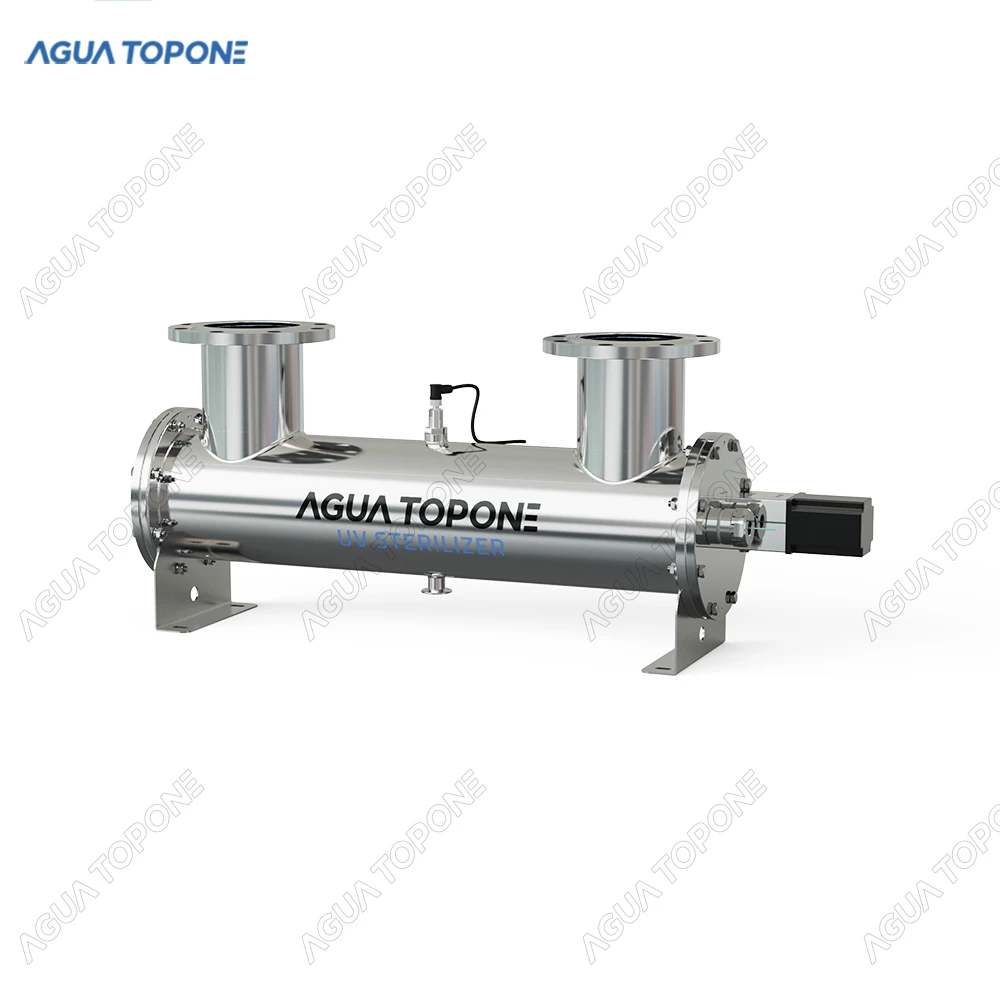
Therefore, unless it is a small application in the home, it is recommended to choose a medium pressure UV system.
2. Advanced: How to judge whether UV light is effective or not?
Choosing the right UV system is the first step, followed by testing whether it is qualified and the technical function is as good as the instructions. To this end, we summarize 4 indicators -
1. Is there third-party verification such as EPA, DVGW, ONROM, etc?
Validating it according to an internationally recognized validation protocol is one way to ensure that a UV system can be used effectively.
The most widely accepted verification protocols are EPA (USA), DVGW (Germany) and ÖNORM (Austria). Without these three validation protocols, caution, caution, and caution are needed before purchasing a UV system.
As the HOD UV technology of the Agua topone Water Optics™ Medium Pressure UV System is approved and validated for 4-log virus and 5-log microbial inactivation through EPA's regulatory standards validation, automated operation and compliance reporting, Antlers Lande has been approved to provide technical support for water biosafety for hospitals, effectively disinfecting pathogenic microorganisms such as SARS-CoV-2 and Legionella.
The authority of the verification protocol is difficult to obtain from third-party verification. Because UV systems need to meet various technical and operational requirements, in addition, the monitoring sensors and overall disinfection performance of the UV system must be certified.
However, beyond validation, monitoring the performance of UV systems is not easy, as site conditions can change rapidly and it is difficult to achieve optimal conditions. Therefore, verification documentation is not enough to ensure that the UV system is functioning properly, we need to look at other things.
2. Is the specified UV dose the "minimum effective dose"?
In order to truly disinfect harmful pathogens, it is necessary to first ensure that the "minimum UV dose" provided in the disinfection room can meet the standard.
The ultraviolet dose refers to the energy of ultraviolet rays received per unit area, and the formula is:
UV dose (mJ/cm²) = UV light intensity (mw/cm²) x residence time (sec)
So, UV dose is a function of water flow (fast water flow, slow dwell), UVT and UV lamp power. An increase in UVT or lamp power directly increases the UV dose, while an increase in flow rate has the opposite effect on the UV dose.
Since all three parameters are directly related to UV dose, they must always be monitored during operation to ensure that the UV system is delivering the desired UV dose.
3. Is there a dedicated sensor for each UV lamp?
It is not a waste to monitor each lamp individually and check the actual performance of the lamp one by one.
If a light fails or is too weak, the system will not deliver the required UV dose and will not keep aquatic life safe.
In this case, the provider's performance guarantee is not enough, real performance must be continuously monitored in real time to confirm the efficacy of the UV system.
Agua topone's technology enables comprehensive microbiological testing from various points to quickly confirm that each UV lamp is functioning properly, physically sterilizing pathogenic microorganisms such as Legionella.
4. Is there an integrated UVT sensor?
UVT is the ultraviolet transmittance, which refers to the ratio of the unabsorbed ultraviolet rays to the total output ultraviolet rays after passing through a 1cm cuvette water sample with a wavelength of 253.7nm.
The higher the dose of 253.7nm, the greater the destructive power to bacteria and the stronger the sterilization.
However, the UVT of water can change dramatically during production due to changes in water source, feed or increase in organic matter in the water.
Plus UVT is one of the most important factors affecting UV dose, so the integrated UVT sensor must always be used to feed back the true UVT value to the controller of the UV system in order to accurately measure UV dose and monitor disinfection effectiveness.
3. Specific to different industries and different application scenarios, how to choose?
As a leader in UV solutions for the water treatment industry, Agua topone designs Water Optics™ medium pressure UV systems serving multiple industries such as food and beverage, municipal, aquaculture, semiconductor, power heavy industry, pharmaceutical and more.
So, how to adapt the best UV sterilization system to the needs of different industries and different application scenarios?
Just answer the following questions, and we can help you provide a deeply customized solution and provide the most suitable selection.
After completing the specific needs investigation and assessment, the experienced technical team and the Chinese local engineer team with many years of on-site experience will conduct specific analysis and on-site technical support for water quality indicators and technological processes to help you confirm the most suitable selection type.
The above is a complete guide on how to choose a UV sterilization system. Welcome to contact us for more detailed and targeted solutions.


