


Two whole-house water descalers can look almost identical and still be designed for very different water conditions. That is the central difference between ScaleDp WD001 and WD001-PLUS. Their housings, installation logic and intended role are similar, but the upgraded model uses a different internal DPSE alloy configuration and has a much wider published water-quality range.
For homeowners, the choice affects how well a product matches the incoming water. For distributors, installers and OEM buyers, it also affects application coverage, quotation accuracy and after-sales risk. A model that works well on stable municipal water may not be the right choice for a high-TDS well-water project with elevated iron.
Quick answer: Choose WD001 for standard residential projects with stable municipal water and moderate hard-water conditions. Choose WD001-PLUS when hardness, TDS or iron is higher, when the source is well or groundwater, or when the project needs a wider operating margin. The published 91% versus 92% scale-inhibition figures are only one part of the decision; the larger practical difference is water-quality adaptability.
What Are WD001 and WD001-PLUS?
WD001 and WD001-PLUS are whole-house physical water descalers installed on the main water supply line. Water passes through the internal DPSE multi-alloy core, which changes how calcium carbonate crystallizes and adheres to surfaces. This helps reduce scale buildup in water heaters, pipes, faucets, and shower fixtures.
- WD001: Designed for municipal water and homes with standard hard-water conditions.
- WD001-PLUS: Designed for higher hardness levels, more complex water conditions, or greater household water demand. Well water should be tested before use.
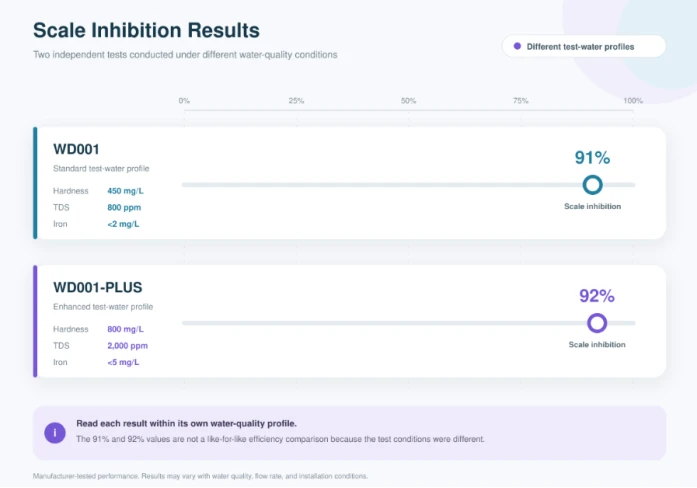
In internal testing, WD001 and WD001-PLUS achieved scale-inhibition rates of approximately 91% and 92%, respectively. This 1% improvement gives WD001-PLUS greater adaptability to challenging water conditions; it does not mean that it removes an additional 1% of calcium or magnesium.
Neither model reduces water hardness or TDS, and neither uses salt, resin, or chemical additives. Their purpose is to reduce scale formation and adhesion-not to turn hard water into soft water.

Why Whole-House Scale Control Matters
Hard water contains dissolved calcium and magnesium. When water is heated, concentrated or repeatedly evaporated, mineral deposits can accumulate on surfaces. The U.S. Geological Survey notes that hard water can produce mineral buildup in plumbing, fixtures and water heaters, restrict pipe diameter and reduce water movement over time.
A point-of-entry treatment strategy aims to influence the water before it reaches multiple vulnerable locations. That makes whole-house scale control relevant where the buyer wants one treatment point for water heaters, showers, faucets and connected equipment rather than a separate device at every outlet.
WD001 vs WD001-PLUS: Key Specifications
|
Parameter |
WD001 |
WD001-PLUS |
Selection meaning |
|
Scale adhesion inhibition* |
Approx. 91% |
Approx. 92% |
One percentage point under standard test conditions. |
|
Hardness |
≤450 mg/L |
≤800 mg/L |
PLUS covers much harder source water. |
|
pH |
3-10 |
3-10 |
Published pH range is the same. |
|
TDS |
≤800 ppm |
≤2000 ppm |
PLUS has a substantially wider dissolved-solids range. |
|
Iron |
<2 mg/L |
<5 mg/L |
Compatibility range, not iron-removal capacity. |
|
Typical water source |
Stable municipal water; some suitable groundwater |
High-mineral municipal water, well water or groundwater |
Always confirm with current test data. |
|
Typical project |
Homes, apartments and small villas |
Large homes, villas and more demanding residential projects |
Flow, pipe size and installation position still matter. |
*Manufacturer-stated values under standard test conditions. Actual site performance depends on water chemistry, flow, temperature, installation and operating conditions.
Why the 1% Improvement Is Bigger Than It Looks
At first glance, 91% and 92% appear nearly identical. They differ by one percentage point, and that number should be described precisely. It is not a claim that WD001-PLUS removes 92% of hardness. It is the manufacturer's reported scale-adhesion inhibition performance under standard test conditions.
Even so, one percentage point can matter when a system operates continuously. In a simple mathematical comparison, a 91% inhibition result leaves nine percentage points outside the inhibited portion, while a 92% result leaves eight. Moving from nine to eight represents about 11.1% less residual share in that specific calculation. This illustration is not a field guarantee, but it shows why a small change near the top of a performance scale can be more meaningful than the headline number suggests.
The stronger reason to consider WD001-PLUS is not the single percentage point by itself. The upgraded nine-alloy design is also associated with a much broader published application envelope:
- Hardness compatibility rises from 450 to 800 mg/L, an increase of about 77.8% in the stated upper limit.
- TDS compatibility rises from 800 to 2000 ppm, making the stated upper limit 2.5 times as high.
- The listed iron threshold rises from below 2 to below 5 mg/L, also a 2.5-times numerical range.
The pH range remains 3-10, so the upgrade is concentrated in mineral loading and water-quality complexity rather than a wider pH specification.
These expanded limits should not be presented as effects caused by the one percentage point alone. Both the 92% test result and the broader water-quality limits are product-level outcomes associated with the upgraded configuration. For a buyer, the practical value is a larger selection buffer and access to sites that may sit outside WD001's recommended range.

Figure 1. Manufacturer-stated performance and water-quality ranges. Bars are normalized within each row because the units differ.
What the 1% Does and Does Not Mean
|
Interpretation |
Practical reading |
|
It does mean |
WD001-PLUS recorded a one-percentage-point higher scale-adhesion inhibition figure under the referenced standard test conditions. |
|
It does mean |
The upgraded model is published for wider hardness, TDS and iron conditions. |
|
It does not mean |
The device removes 92% of calcium, magnesium, TDS or iron from the water. |
|
It does not mean |
Every installation will reproduce exactly 92% performance regardless of flow, temperature, chemistry or installation. |
|
It does not mean |
WD001 is an inferior choice when the project is comfortably inside its stated range. |
How Water Quality Changes the Model Decision
1. Hardness
Water hardness reflects mainly dissolved calcium and magnesium. USGS classifies water above 180 mg/L as CaCO3 as very hard, although a local project still requires a current water report. On the published ScaleDp ranges, both models reach well into very-hard-water territory, while WD001-PLUS extends considerably farther.
2. Total Dissolved Solids
TDS represents the combined concentration of dissolved substances. It is not a scale-mineral test by itself, but high TDS can signal a more mineralized and variable water environment. A project at 1100 ppm TDS may still have manageable hardness, yet it already exceeds WD001's listed TDS range and therefore points toward WD001-PLUS or a more detailed technical review.
3. Iron
Iron can contribute color, staining, rust particles and mixed deposits. The published iron figures describe the water conditions the models are intended to tolerate; they do not mean either device is an iron-removal filter. If iron is near the relevant limit, source-water pretreatment should be assessed.
4. Source Stability
Municipal water is often more stable than private well water, although this varies by location. Well and groundwater chemistry can change with season, pumping pattern and local geology. A distributor serving such a market may prefer the wider WD001-PLUS envelope even when one sample falls inside WD001 limits, especially if future variation and after-sales exposure are important.
Where Each Model Fits Best
|
Site condition |
Likely direction |
Why |
|
Stable municipal water; moderate scale |
WD001 |
Cost-effective coverage when all measured values remain within range. |
|
High hardness or TDS |
WD001-PLUS |
Wider published limits provide a better technical match. |
|
Well or groundwater |
WD001-PLUS / review |
Test hardness, TDS, pH and iron; add pretreatment where needed. |
|
Large villa or higher-demand home |
WD001-PLUS / review |
Confirm peak flow, pipe size and fixture demand as well as chemistry. |
|
Sediment or visible rust particles |
Prefilter first |
A scale-control device should not be used as a sediment filter. |
|
Water report close to a model limit |
Use engineering margin |
Select the wider model or request technical confirmation rather than sizing to the edge. |
When Is a Pre-Filter or Pretreatment Required?
A physical water descaler and a filtration system solve different problems. If the incoming water contains sediment, suspended solids or rust particles, a pre-filter should remove those solids before the water reaches the ScaleDp unit. This protects the wider water system and allows the descaler to perform its intended scale-control role.
For well water, groundwater or water with elevated iron, the decision should be based on a laboratory or utility report. When iron approaches the product's published threshold, an iron-removal stage or another suitable pretreatment process may be necessary. The correct sequence is source-water analysis, removal of incompatible contaminants, then scale control.
A Five-Step Selection Process for Buyers
- Identify the water source: municipal supply, well water, groundwater or mixed source.
- Collect current hardness, pH, TDS and iron values. Do not select from appearance or geography alone.
- Confirm pipe size, peak flow, installation position and the number of downstream water-use points.
- Choose WD001 when the project is comfortably within its limits; choose WD001-PLUS when chemistry is more demanding or variable.
- Add sediment, iron or other pretreatment when the water report shows a separate contaminant problem.
This workflow is especially important for distributors. A slightly higher product cost can be easier to defend than repeated field visits, product returns or customer complaints caused by selecting a model at the edge of its intended range.
Watch the WD001 and WD001-PLUS Video Comparison
The product video provides a useful visual companion to the specifications in this guide. It can help sales teams and buyers recognize the two models and understand the comparison before discussing water data and project conditions.
Frequently Asked Questions
Is WD001-PLUS always the better choice?
No. If the water is stable and comfortably inside WD001's listed range, WD001 may be the more economical and appropriate model. The goal is correct fit, not buying the highest specification by default.
Does 92% scale inhibition mean 92% water softening?
No. Scale inhibition and water softening are different functions. The stated figure refers to scale-adhesion inhibition under standard test conditions. It does not describe calcium or magnesium removal.
Can either model remove sediment or iron?
They are not sediment filters or dedicated iron-removal systems. A pre-filter or iron-treatment stage may be required, depending on the water report.
Why does WD001-PLUS cover more sites if the test result is only one point higher?
Because the choice is based on the full product specification, not one percentage alone. The upgraded nine-alloy configuration is paired with wider published limits for hardness, TDS and iron. Those limits allow WD001-PLUS to match water sources and projects that sit outside WD001's intended range.
What information should a distributor send for model selection?
Start with water source, hardness, pH, TDS, iron, pipe size, peak flow, intended installation position and photos of the available pipework. More detailed analysis can follow if the source is variable or the readings approach a model limit.
Conclusion: Select the Water-Quality Envelope, Not the Appearance
WD001 and WD001-PLUS show why visually similar water-treatment products cannot be selected by housing or price alone. WD001 is designed as a practical whole-house water descaler for standard residential water. WD001-PLUS adds a nine-alloy DPSE configuration, a one-percentage-point higher published inhibition result and, more importantly, a much wider hardness, TDS and iron envelope.
For buyers, that wider envelope can mean more addressable regions, better coverage of well-water and high-mineral markets, and a larger margin between the tested water and the model limit. The right decision still begins with water data.
Need a model recommendation? Send ScaleDp your water report and project details for a technical review of water quality, pipe size and installation position.


