


When it comes to drinking water safety, many people are familiar with reverse osmosis (RO): water passes through an extremely fine membrane, while bacteria, viruses, and other contaminants are rejected and discharged with the concentrate water. However, does installing RO on the main household water line provide the best protection for the entire home?
The answer depends on the actual water quality concerns. If the goal is to remove dissolved salts or specific chemical contaminants, RO has clear advantages. However, if the main objective is to control the risk of bacteria and viruses throughout the entire household water system, ultraviolet (UV) disinfection is often a more practical technology to consider. The key is not which technology is "more advanced," but that they solve different water treatment challenges.
1. First Understand the Difference Between "Removal" and "Inactivation"
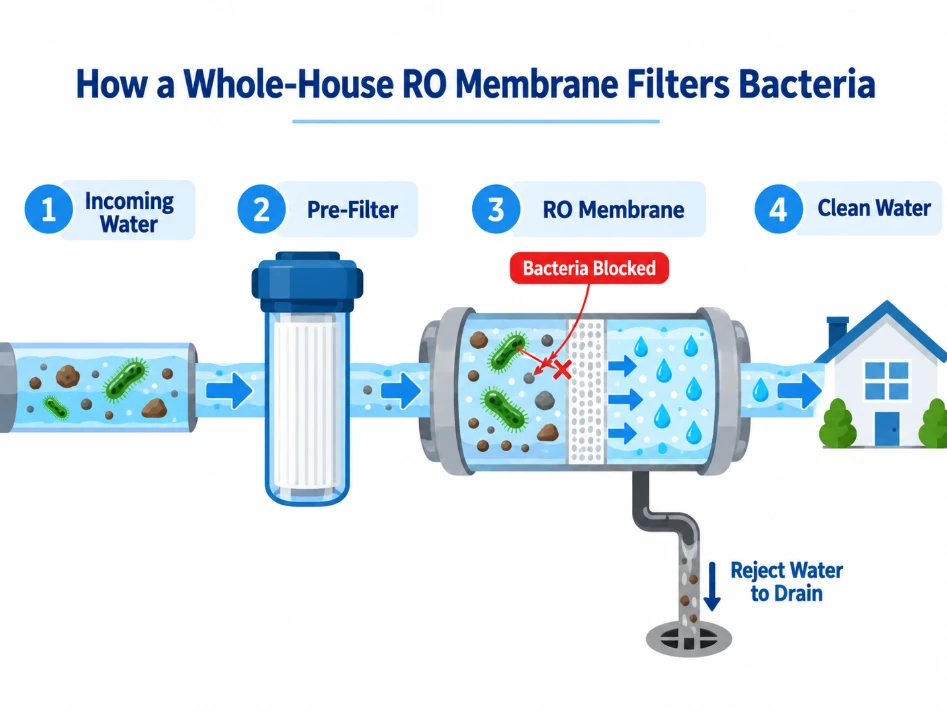
RO Is Physical Separation
Reverse osmosis is a physical filtration process. Under pressure, water passes through a semi-permeable membrane, while bacteria, viruses, and some dissolved substances are rejected by the membrane and separated from the treated water.
The actual performance depends on the specific system design, membrane condition, operating pressure, and maintenance status.
RO removes or separates contaminants from water through membrane filtration.
UV Is On-Site Disinfection
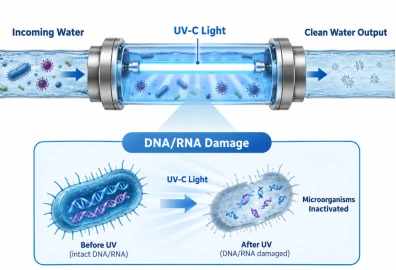
UV disinfection works differently. When water passes through a UV reaction chamber, microorganisms are exposed to sufficient UV-C energy, which damages their genetic material and prevents them from reproducing or causing infection.
UV does not physically remove microorganisms from water, nor does it remove dissolved salts, heavy metals, or chemical contaminants.
Its function is highly specific:
To reduce microbial activity at the moment water passes through the UV chamber.
2. Why Does UV Have Advantages in Whole-House Applications?
Kitchen drinking water usage is relatively limited, so RO systems are often used for point-of-use drinking and cooking water. Whole-house water treatment is different.
A whole-house system must handle multiple water outlets operating at the same time, including:
Showers
Washing machines
Kitchen faucets
Bathrooms
Other household water points
The system must not only achieve the treatment goal but also maintain sufficient flow during peak demand.
To treat the entire household water supply with RO, a much larger production capacity is usually required, together with additional equipment such as:
Storage tanks
Booster pumps
Concentrate discharge systems
The U.S. Environmental Protection Agency (EPA) has noted that whole-house RO applications may require additional storage and pumping systems, while membranes and filters also require regular maintenance.
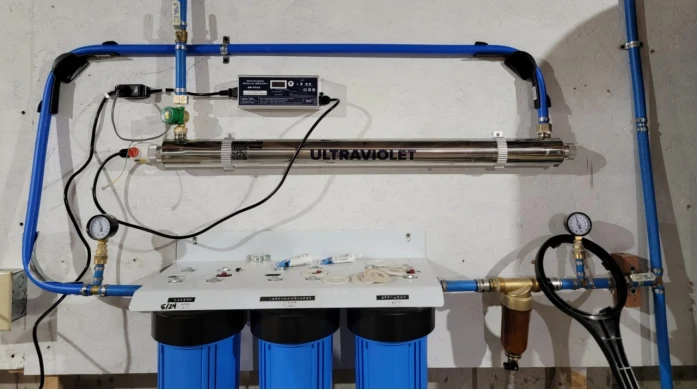
UV, on the other hand, can be installed directly on the main water line. After proper pre-filtration, water passes through the UV reactor and continues to all household outlets.
For whole-house systems where microbial control is the primary goal and maintaining high flow rates is important, this is where UV provides its practical advantage.
It does not need to continuously produce large volumes of purified water like RO, and it does not generate RO reject water.
However, "suitable for whole-house use" does not mean that simply installing a UV lamp is enough. The actual performance depends on whether every flow of water receives the required UV dose under real operating conditions.
3. How Does UV Inactivate Bacteria and Viruses?
UV-C ultraviolet technology is widely used in drinking water disinfection and can effectively control bacteria, viruses, and other microorganisms.
Its working principle is not filtration or physical removal. Instead, UV-C energy damages the genetic material (DNA or RNA) inside microorganisms, preventing them from reproducing and causing infection.
When water flows through a UV reactor, UV-C light (typically in the 200–280 nm wavelength range) penetrates microorganisms and is absorbed by their DNA or RNA.
The UV energy damages the chemical structure of genetic material, causing DNA/RNA damage or abnormal structures that prevent replication.
Even if microorganisms remain physically present in the water, they are no longer able to reproduce or infect. This process is called microbial inactivation.
How UV Works on Bacteria
Bacteria such as E. coli and other microorganisms contain DNA as their genetic material.
When exposed to UV-C light, the DNA structure is damaged, affecting genetic information processing and cell reproduction.
Normally:
Intact DNA → Normal replication → Bacterial growth
After UV exposure:
UV-C exposure → DNA damage → Unable to reproduce → Bacterial inactivation
Therefore, UV can rapidly reduce bacterial activity and provide effective microbial control in water treatment systems.
How UV Works on Viruses
Viruses are different from bacteria. They do not have a complete cellular structure and cannot reproduce independently. Instead, they rely on their DNA or RNA genetic material to replicate inside host cells.
The main effect of UV-C on viruses is:
DNA/RNA damage → Genetic information disruption → Unable to replicate → Virus inactivation
Both DNA viruses and RNA viruses can be inactivated through appropriate UV exposure. However, different viruses have different UV sensitivities due to variations in their genetic structure.
Therefore, the performance of UV systems must be evaluated based on:
Specific microorganism type
Required inactivation level
UV dose
Water quality conditions
Reactor design
A test result for one microorganism cannot automatically represent performance against all bacteria or viruses.
4. Four Key Factors for Effective Whole-House UV Disinfection
1. Remove Water Quality Issues That Affect UV Transmission
UV must directly reach microorganisms to work effectively.
If water contains:
High turbidity
Suspended particles
Sediment
These particles may shield microorganisms from UV exposure and reduce UV penetration.
Therefore, UV systems usually require appropriate pre-filtration based on raw water conditions.
The U.S. Centers for Disease Control and Prevention (CDC) also recommends that UV systems with proper pre-filtration generally perform better than systems without filtration.
2. Select the System Based on Peak Flow Rate
A household may have multiple water outlets operating simultaneously.
During peak demand, flow rates can increase significantly compared with normal usage.
If the actual flow exceeds the validated treatment capacity of the UV system, the exposure time inside the reactor decreases, which may reduce the delivered UV dose.
Therefore, whole-house UV selection should be based on:
Actual maximum flow rate + validated disinfection performance
rather than only pipe size or the product name "whole-house UV."
3. Pay Attention to Operation and Maintenance
UV performance depends on system condition.
Over time:
UV lamp output gradually decreases.
Quartz sleeves may accumulate scale or deposits.
Reduced light transmission can affect UV delivery.
Regular maintenance should include:
Lamp replacement according to manufacturer recommendations
Quartz sleeve cleaning
Checking system alarms and operation status
For applications requiring higher microbial protection, users should carefully review the product's validated performance range and certification information.
4. Consider Storage Tanks and Downstream Plumbing
UV works when water passes through the reactor.
It does not provide continuous disinfection protection inside downstream pipes.
If treated water enters:
Poorly maintained storage tanks
Long stagnant pipelines
Systems with microbial growth risks
Water quality may still be affected after UV treatment.
For homes with storage tanks, the UV installation location should be carefully considered. In many cases, installing UV after the storage tank can provide better protection for downstream household water.
If activated carbon filtration removes chlorine residual from municipal water, additional attention should be given to potential microbial regrowth in the plumbing system.
5. When Should You Choose RO and When Should You Prioritize UV?
The choice should start with water quality testing.
Main concern: bacteria and viruses, with whole-house water treatment required
Consider:
Proper pre-filtration
A correctly sized UV disinfection system
Verified UV performance under actual operating conditions
Drinking water contains dissolved salts or specific chemical contaminants
Consider:
RO systems
If only drinking and cooking water requires purification, a point-of-use RO system may be more practical than whole-house RO.
RO and UV are not necessarily competing technologies.
Some systems combine both:
RO removes specific dissolved contaminants from drinking water.
UV provides microbial control depending on system design and application.
The correct solution depends on:
Water quality
Plumbing layout
Storage conditions
Actual treatment requirements
The CDC recommends testing water quality and selecting treatment methods based on the specific contaminants or microorganisms present.
Conclusion
For whole-house microbial control, the key advantage of UV is that it can disinfect water continuously as it enters the home while maintaining high flow rates. RO, on the other hand, provides broader contaminant removal capability, including certain dissolved substances that UV cannot address.
A reliable whole-house UV system is not simply a combination of a pre-filter and a UV lamp.
The real performance depends on the combination of:
Raw water quality
Pre-filtration
Maximum flow rate
Validated UV dose
Installation location
Proper maintenance
Only when these factors are correctly matched can a whole-house UV system provide reliable protection against bacteria and viruses under real household operating conditions.


